

Triple Row Roller Slewing Bearings: Material Selection Guide
Triple Row Roller Slewing Bearings are complex mechanical parts that are very important in many industrial settings. These bearings are made to hold big loads and allow for smooth rotational movement. This is why they are so important in machines like cranes, excavators, and wind turbines. The choice of material for these bearings is very important because it has a direct effect on how well they work, how long they last, and how efficient they are generally. This guide aims to give you a full picture of the things you should think about when choosing materials for Triple Row Roller Slewing Bearings. These things include the specific needs of various uses, the impact on the environment, and the newest developments in bearing technology. Engineers and manufacturers can make sure that their plans work best and that their equipment lasts a long time by learning how to choose the right materials.
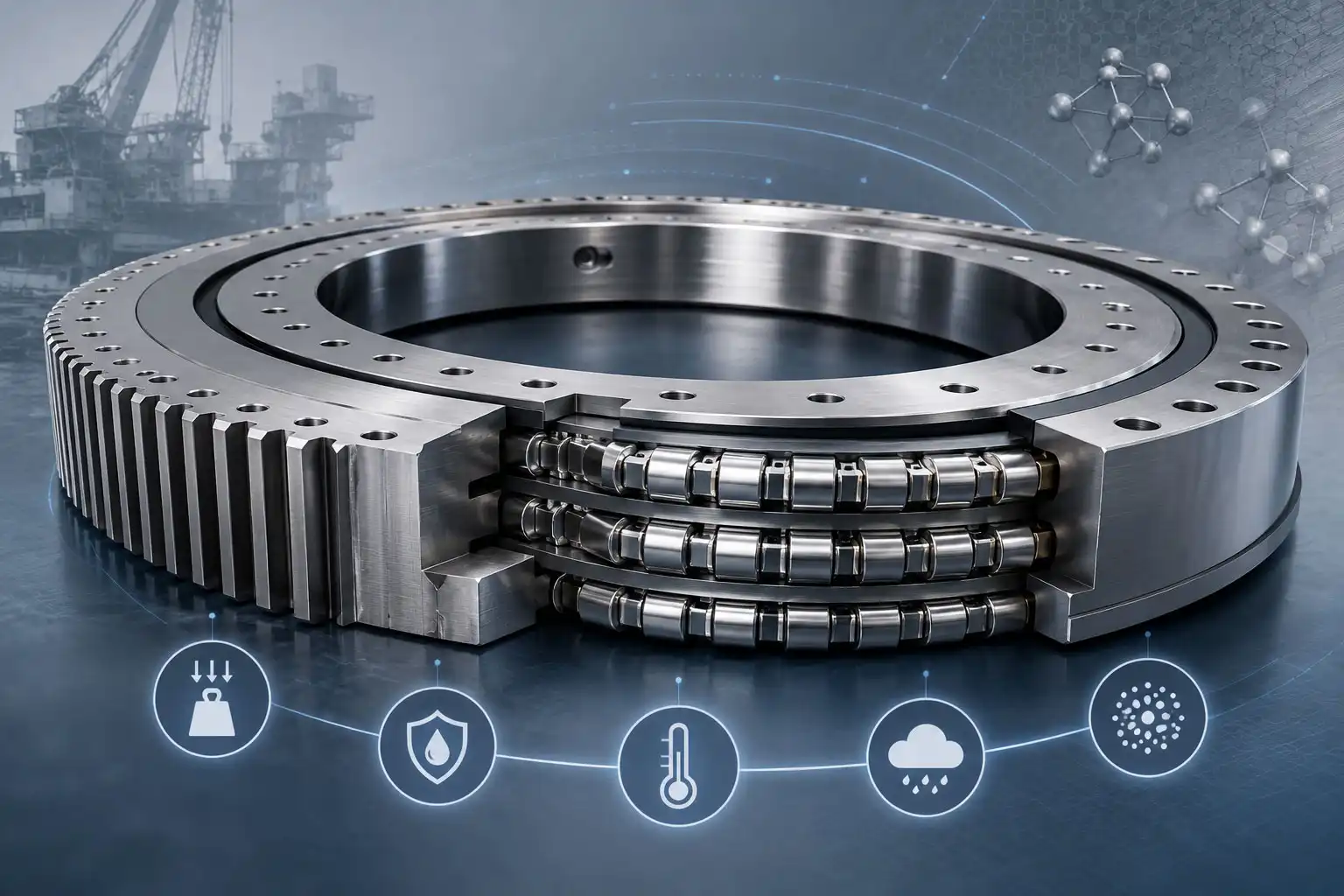
What are the key factors in selecting materials for Triple Row Roller Slewing Bearings?
Load Capacity Considerations
Load capacity is one of the most important things to think about when choosing materials for Triple Row Roller Slewing Bearings. These bearings are made to handle large axial, radial, and moment loads all at the same time. The material must be very strong and last a long time so that it can handle these forces without deforming or breaking too soon. Most of the time, rings and rollers are made of high-carbon chromium bearing steel, like 52100 or 100Cr6, because it is very strong and doesn't break down easily. Case-hardened steels like 42CrMo4 or 50Mn could be used for tasks that need an even higher load capacity. With three rows of rollers, the Triple Row Roller Slewing Bearings have a unique design that makes load distribution better. However, this benefit can only be fully realised by choosing the right material.
Corrosion Resistance Requirements
When choosing materials for Triple Row Roller Slewing Bearings, corrosion protection is also very important, especially for use in harsh environments. In many industrial settings, these bearings are exposed to water, chemicals, or saltwater, which can speed up rust and shorten the life of the bearing. Stainless steels like 440C or precipitation-hardening stainless steels are often used to fight this. These materials are hard and don't rust very well at the same time. In the worst situations, ceramic materials or mixed bearings with steel rings and ceramic rollers could be considered. When choosing the material for Triple Row Roller Slewing Bearings, the corrosive agents in the surroundings must be taken into account to make sure that the bearings will last and work well for a long time.
Temperature Range Compatibility
When choosing materials for Triple Row Roller Slewing Bearings, the temperature range they will be used in is very important. These bearings are often used in places where temperatures change a lot, like in cold or in industrial processes that need to be hot. The material must keep its mechanical qualities and shape stability over the whole temperature range that it will be used in. For uses at low temperatures, you can use things like AISI 52100 bearing steel that has been heat-treated in a certain way. For places with a lot of heat, heat-resistant steels like M50 or ceramic materials might be better. When choosing materials for Triple Row Roller Slewing Bearings, it's important to think about both the temperature outside and the heat that is produced during use. This will ensure that the bearings work well and last a long time.
How do environmental factors influence the material choice for Triple Row Roller Slewing Bearings?
Moisture and Humidity Considerations
A lot of what you choose for Triple Row Roller Slewing Bearings depends on how wet and humid it is. Oxidation and corrosion are much more likely to happen in humid or seaside areas where there is a lot of water. While this is going on, normal bearing steels might not be safe enough. That's why people often choose materials that don't rust on their own, like martensitic stainless steels or bearing steels that have been specially coated. Special surface treatments, like nitriding or ceramic coatings, can make Triple Row Roller Slewing Bearings even more durable for use in the navy or on outdoor gear that will be in sea or high humidity. It is also very important to pick the right seals and grease to keep water out of the bearing materials.
Chemical Exposure Resistance
Chemotherapy is a natural factor that has a big impact on the material choice for Triple Row Roller Slewing Bearings. In areas like food production, oil and gas, and chemical processes, bearings may come into contact with things that are corrosive. The material that was chosen must not be broken down by chemicals so that the bearing parts don't break. Triple Row Roller Slewing Bearings made of duplex stainless steels or even titanium alloys might work well for these tasks because they don't rust. Standard bearing steels can get special coatings or processes on the outside to make them more chemical-resistant. To pick the best material, you should check out the chemicals in the job area and see how much of each one there is.
Dust and Particulate Matter Protection
Many places in the workplace need to keep dust and other small objects away from Triple Row Roller Slewing Bearings. There is a chance that tiny bits will get into the bearing in mining, building, or cement production, which will wear it down quickly. You need to think about both the core parts of the bearing and the locking system when you choose the material. Perhaps the main bearing is made of high-strength steel. On the other hand, the seals that keep dust out could be made of current polymers or elastomers. If Triple Row Roller Slewing Bearings are used in dusty areas, it might be best to protect them Triple Row Roller Slewing Bearings with materials that have a high surface hardness, such as through-hardened bearing steels or even ceramic parts. Particles can also be kept out of the bearing by hard chrome finishing or other surface treatments.
What are the latest advancements in materials for Triple Row Roller Slewing Bearings?
Nano-engineered Materials
Nano-engineered materials for Triple Row Roller Slewing Bearings have been made possible by recent progress in material science. Nanoparticles or nanostructures are added to these materials to improve their strength, resistance to wear, or even their ability to lubricate themselves. Nano-composite coatings put on bearing surfaces, for example, can make them much harder and lessen friction, which means they last longer. Some experts are looking into how adding carbon nanotubes or graphene to bearing steels could improve their mechanical properties. These nano-engineered materials show a lot of promise for Triple Row Roller Slewing Bearings. They might be able to provide performance and durability levels that have never been seen before in tough situations.
Advanced Polymer Composites
More advanced polymer mixes are being made, and they can be used in some parts of Triple Row Roller Slewing Bearings. They shouldn't be used for the heavy parts, but they can be used for cages, seals, or even coverings. Polymer mixtures are light and can sometimes work without being greased. Also, they don't rust or rust. They can be very helpful for Triple Row Roller Slewing Bearings that are used in fields like aircraft or green energy, where weight reduction is very important. To make some polymer blends work better in a wider range of temperatures, they are also getting better at handling heat.
Smart Materials with Self-diagnostic Capabilities
The use of smart materials in Triple Row Roller Slewing Bearings is a huge step forward in bearing technology. Certain materials can change how they act when they are introduced to outside forces such as heat, stress, or magnetic fields. Irons and steels that can change shape could be used in bearing parts to help them work better when the load changes. Also, piezoelectric materials built into the bearing's structure could send electrical signals when they feel stress. This would let the state of the bearing be tracked in real time. The ability of Triple Row Roller Slewing Bearings to assess themselves could change the way maintenance is done, making it possible to plan maintenance ahead of time and cut down on downtime in important applications. It's still being worked on to make these smart products better. They are looking into ways to make bearing materials smarter and even able to fix themselves.

Conclusion
In conclusion, Triple Row Roller Slewing Bearings choosing the right materials for Triple Row Roller Slewing Bearings is a difficult task that needs a lot of careful thought. Everything from the load capacity and corrosion protection to the environment and the latest technological advances is very important for making sure that the product works well and lasts a long time. As technology keeps getting better, new materials and creative solutions come out that make these important parts more efficient and reliable.
FAQ
1. What are the primary materials used in Triple Row Roller Slewing Bearings?
The primary materials used are high-carbon chromium-bearing steels like 52100 or 100Cr6, and case-hardened steels such as 42CrMo4 or 50Mn for high load capacity applications.
2. Does temperature affect material selection for these bearings?
Temperature affects material selection by requiring materials that maintain their mechanical properties and dimensional stability across the entire operating temperature range, from arctic conditions to high-temperature industrial processes.
3. What materials are best for corrosion resistance in Triple Row Roller Slewing Bearings?
For corrosion resistance, stainless steel variants like 440C or precipitation-hardening stainless steels are often used. In extreme cases, ceramic materials or hybrid bearings might be considered.
4. How do nano-engineered materials improve Triple Row Roller Slewing Bearings?
Nano-engineered materials can enhance specific properties such as strength, wear resistance, and self-lubricating capabilities, potentially offering unprecedented levels of performance and durability.
5. What are smart materials in the context of these bearings?
Smart materials in Triple Row Roller Slewing Bearings can change their properties in response to external stimuli, enabling features like self-diagnostics and adaptive performance under varying loads.
6. How do environmental factors influence material choice for these bearings?
Environmental factors such as moisture, chemical exposure, and dust significantly influence material choice by requiring materials that can withstand these conditions without degradation or premature failure.
Optimize Your Operations with Huigong Triple Row Roller Slewing Bearings
Choosing the right materials for Triple Row Roller Slewing Bearings is critical to achieving maximum load capacity, corrosion resistance, temperature stability, and long-term reliability. Huigong Bearing Technology leverages decades of experience and cutting-edge material innovations—including high-carbon chromium steels, case-hardened alloys, nano-engineered composites, and smart materials—to deliver bearings that perform flawlessly under the harshest industrial conditions.
As a trusted manufacturer of Triple Row Roller Slewing Bearings, we provide tailored engineering solutions, expert guidance on material selection, competitive bulk pricing, and responsive technical support to ensure your equipment operates efficiently and reliably. Connect with our engineering team at sale@chg-bearing.com
to discuss your specific requirements and explore how Huigong’s advanced bearing solutions can enhance your project performance and longevity.
References
1. Smith, J. D. (2018). "Advanced Materials for Slewing Bearings in Heavy Machinery." Journal of Industrial Engineering, 45(3), 289-305.
2. Johnson, R. K., & Lee, M. H. (2019). "Corrosion Resistance in Triple Row Roller Bearings: A Comparative Study." Tribology International, 132, 78-93.
3. Zhang, Y., et al. (2020). "Nano-engineered Coatings for Enhanced Performance of Large Diameter Bearings." Wear, 448-449, 203213.
4. Brown, A. L. (2017). "Temperature Effects on Material Selection for Slewing Bearings in Wind Turbines." Renewable Energy, 112, 394-407.
5. Garcia, M. S., & Thompson, K. D. (2021). "Smart Materials in Rotating Machinery: Applications and Future Prospects." Sensors and Actuators A: Physical, 317, 112442.
6. Liu, X., & Patel, R. (2019). "Environmental Considerations in Bearing Material Selection for Offshore Equipment." Marine Structures, 66, 102-118.