

How Do Cross Roller Slewing Bearings Improve Rotational Stability?
In heavy machinery, construction equipment, and precision military or aerospace systems, maintaining smooth and stable rotation under extreme combined loads is a fundamental engineering requirement. The Cross Roller Slewing Bearing addresses this requirement through a distinctive internal architecture — cylindrical rollers arranged in a 1:1 alternating cross pattern — that delivers high stability, precision, and impact resistance within a single large-diameter bearing unit. This article explains how the Cross Roller Slewing Bearing works, what design features drive its rotational stability advantages, how to select the right type for your equipment, and how to keep it performing reliably over its full service life.
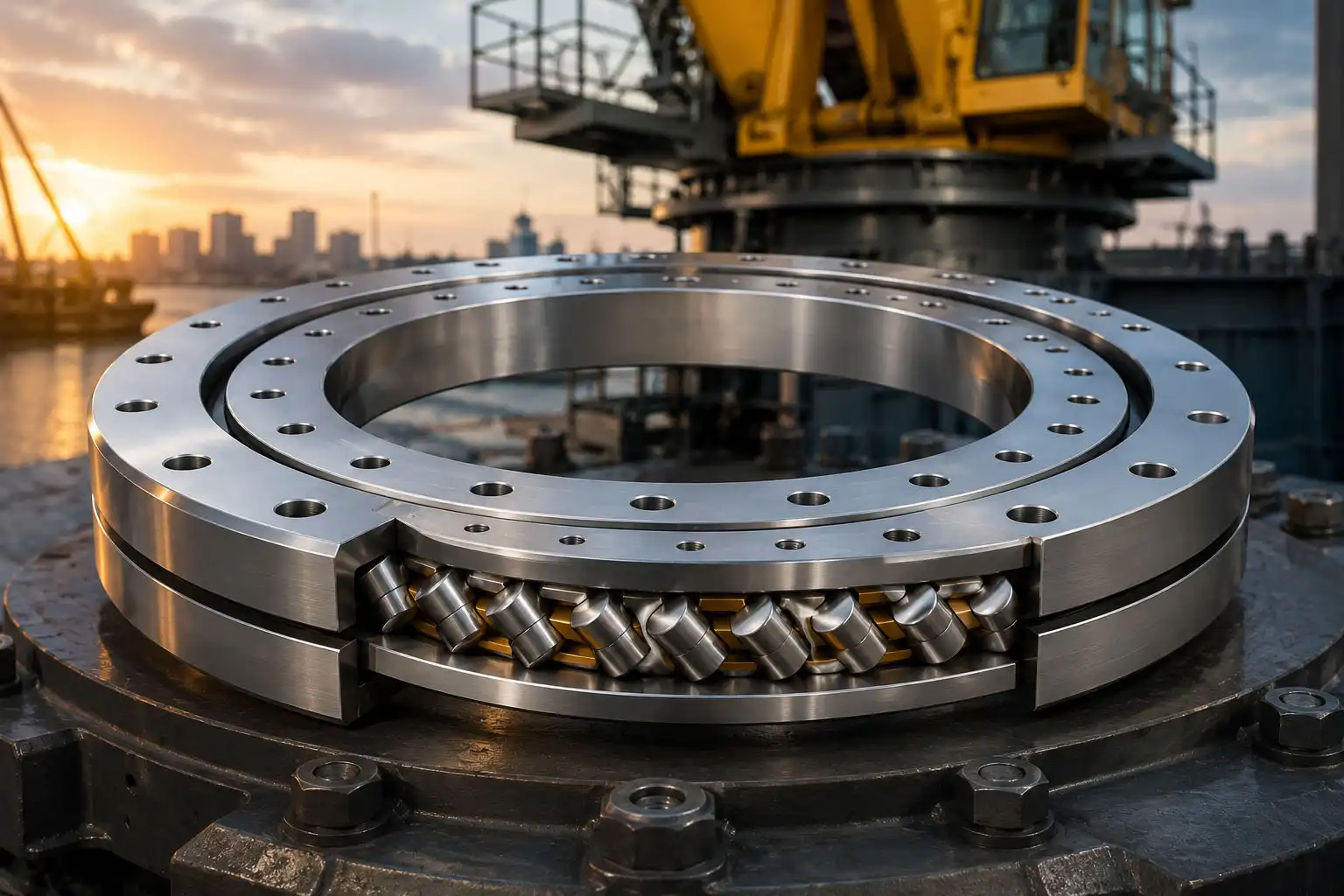
What Is a Cross Roller Slewing Bearing and How Does It Work
The Cross-Arranged Roller Architecture
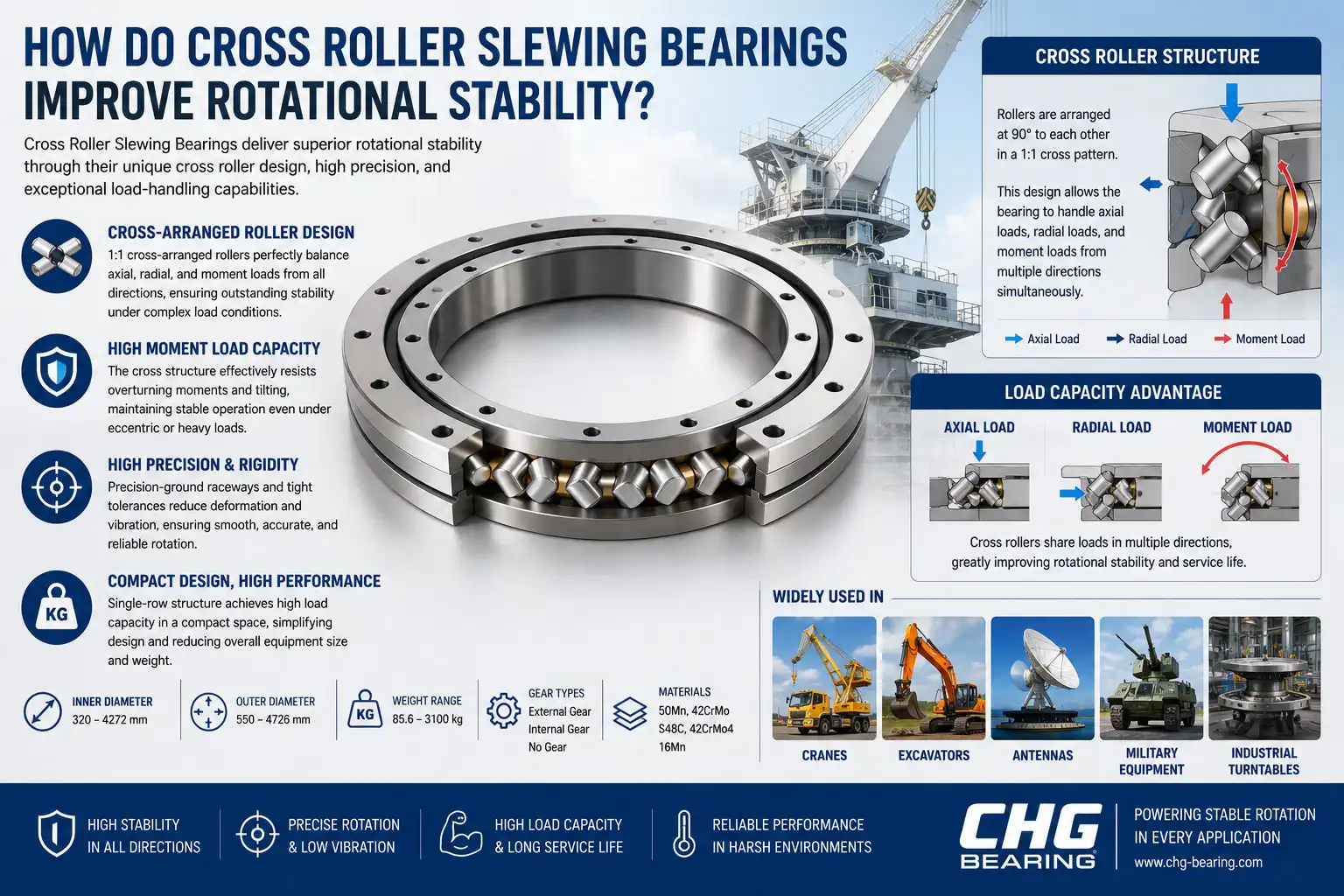
The Cross Roller Slewing Bearing gets its name from the way its circular rolling parts are arranged in pairs at right angles. Within a single raceway channel, adjacent wheels are set up opposite one another. This makes a cross design that lets the bearing fight forces in more than one direction at the same time. In contrast, traditional slewing rings that use ball bearings or parallel rollers are not as good at controlling moment loads and axial and rotational forces together in a small space. Because the rollers are arranged in a cross shape, each one shares the load in a different plane. This makes for a very stable rotating platform, even when outside forces change direction and size.
Three Gear Configurations for Different Drive Arrangements
The Cross Roller Slewing Bearing from CHG Bearing comes in three different gear types: external gear, internal gear, and no-gear (plain). External gear types are moved from outside the outer ring of the bearing. They are often used when the drive pinion needs to be placed around the edge of the slewing assembly, like on many crane and loader turntables. With an internal gear type, the drive gear is on the inner ring, which makes the drive setup smaller. People use no-gear models when the bearing is moved by friction, hydraulics, or a different type of drive. They come in a wide range of sizes, with inner diameters starting at 320 mm (no-gear) and going up to 427 mm (geared), and outer diameters going up to 4726 mm.
Materials Engineered for Heavy-Duty Reliability
The quality of the ring material has a big impact on how well a Cross Roller Slewing Bearing works. CHG Bearing uses a number of well-known industrial steels, including 50Mn, 42CrMo, S48C, 42CrMo4, and 16Mn. Each was picked because it has a different mix of strength, stiffness, hardenability, and weldability for Cross Roller Slewing Bearing applications. Alloy steels 42CrMo and 42CrMo4 have great through-hardening and wear protection for the most challenging load cycles. 50Mn has a lot of carbon and manganese, which makes the surface harder after it has been heated. 16Mn is a type of structural steel that is chosen when it needs to be easy to weld, like in pre-made support structures. It is important that the material specifications fit the bearing size, the load needs, and the working climate of the Cross Roller Slewing Bearing.
Key Design Features That Enhance Rotational Stability
1:1 Roller Cross-Arrangement and Load Distribution
The defining stability advantage of the Cross Roller Slewing Bearing comes directly from its alternating roller orientation. Because each roller is perpendicular to its neighbors, the bearing simultaneously resists axial forces from above and below, radial forces from any lateral direction, and overturning moment loads generated by offset or cantilevered loads. No single loading direction can overcome the bearing's resistance, because rollers oriented in the complementary direction are always engaged. This is why the Cross Roller Slewing Bearing is specified for the rotary bases of artillery systems and precision radar platforms, where load direction changes rapidly, and stability cannot be compromised under any operating condition.
High Moment Load Resistance in a Single-Row Structure
One of the most operationally significant features of the Cross Roller Slewing Bearing is its ability to carry high moment loads within a single-row, single-raceway structure. In conventional slewing rings, large moment loads typically require multi-row configurations or additional supplementary bearings to prevent ring tilting under eccentric loading. The cross-roller geometry eliminates this need in many applications, simplifying the supporting structure and reducing overall assembly height and weight. For crane booms, excavator upper structures, and industrial turntables that routinely operate with eccentric payloads, this moment-resisting capability directly translates to safer, more predictable rotational behavior.
Precision Raceway Geometry and Running Accuracy
Rotational stability is not only about load capacity — it also depends on the precision of the raceway geometry that guides each roller in a Cross Roller Slewing Bearing. CHG Bearing produces Cross Roller Slewing Bearings with tightly controlled raceway form tolerances verified using roundness meters, CMMs, and surface finish instruments. Accurate raceway geometry ensures uniform load distribution across all rollers at any rotational position, preventing the localized contact stress concentrations that cause premature fatigue pitting. For precision radar antennas and missile launcher platforms, this running accuracy in a Cross Roller Slewing Bearing is directly tied to pointing precision and system performance — bearing runout translates one-to-one into angular positioning error of the payload.
Table: CHG Cross Roller Slewing Bearing — Size and Configuration Overview
Type | Inner Diameter | Outer Diameter | Weight Range | Typical Drive |
No Gear | 320 – 4272 mm | 550 – 4726 mm | 85.6 – 3100 kg | Friction / hydraulic/separate drive |
Internal Gear | 398 – 4272 mm | 602 – 4726 mm | 80 – 3100 kg | Drive pinion on the inner ring |
External Gear | 398 – 4272 mm | 602 – 4726 mm | 80 – 3100 kg | Drive pinion on the outer ring |
How to Choose the Right Cross Roller Slewing Bearing for Your Equipment
Calculating Combined Loads: Axial, Radial, and Moment
Selecting a Cross Roller Slewing Bearing begins with accurately characterizing all loads the bearing must carry simultaneously. Axial load (the vertical force acting along the bearing axis), radial load (lateral force perpendicular to the axis), and tilting moment (the overturning torque from offset loads) must all be quantified across the full operating envelope of the machine — including dynamic load peaks during acceleration, emergency stops, and worst-case payload positions. Many manufacturers, including CHG Bearing, provide equivalent load formulas that combine these three load components into a single comparative value for bearing selection from load capacity tables. Undersizing any of the three load components leads to shortened service life or unexpected failure.
Gear Type Selection and Drive System Compatibility
After establishing load requirements, the next selection step for a Cross Roller Slewing Bearing is choosing the gear configuration that matches your drive system. External gear variants offer easier pinion positioning and are standard in most mobile crane and excavator turntable designs. Internal gear types provide a lower profile drive arrangement and are preferred where overall height is constrained or where the drive must be enclosed within the slewing ring diameter. No-gear versions suit applications driven by independent mechanisms such as hydraulic motors through friction wheels, or where the slewing motion is directly actuated. CHG Bearing's engineering team can assist in specifying module, tooth count, and backlash requirements to match your drive pinion and gear motor selection.
Size, Weight, and Structural Interface Considerations
For very large Cross Roller Slewing Bearings — outer diameters exceeding 2000 mm and weights approaching 3100 kg — structural interface design becomes as important as bearing selection itself. The mounting flanges and bolting arrangements must be sufficiently stiff to prevent the bearing rings from distorting under load, as ring distortion directly compromises roller-to-raceway contact and accelerates wear. CHG Bearing provides mounting flange recommendations and bolt torque specifications to ensure proper interface stiffness. Transportation and installation logistics for very large bearings also require planning — CHG Bearing's project engineering support covers these practical considerations for customers procuring large-diameter slewing systems for port cranes, wind turbine pitch drives, and similar equipment.
Maintenance Tips to Ensure Long-Term Performance and Reliability
Lubrication of the Raceway and Gear Teeth
The Cross Roller Slewing Bearing has two distinct lubrication requirements that must be addressed independently. The roller raceway system requires grease of sufficient viscosity and load-carrying capacity to maintain a protective film between rollers and raceways through the Cross Roller Slewing Bearing's full load and speed range. Most slewing ring manufacturers, including CHG Bearing, specify a lithium-based or lithium-complex grease for raceway lubrication. The gear teeth on external or internal gear variants require a separate gear lubricant — typically an open-gear grease or spray lubricant — applied on a schedule based on operating frequency and environmental exposure. Mixing raceway and gear lubricants is not recommended, as their additive packages are formulated for different contact conditions.
Bolt Tension Monitoring and Structural Inspection
A Cross Roller Slewing Bearing is only as reliable as its mounting interface. The high moment loads these bearings carry are transferred to the supporting structure entirely through the mounting bolts, and bolt tension must be maintained within specified limits throughout the bearing's service life. CHG Bearing recommends verifying bolt torque at the first 100 operating hours after installation and at regular intervals thereafter, as settling and load-induced relaxation can reduce bolt tension over time. Simultaneously, inspect the mounting flanges for cracking, corrosion, or deformation, particularly around bolt holes where stress concentrations are highest. Any flange distortion should be corrected before it compromises the bearing ring's form.
Wear Monitoring and Clearance Measurement
Over time, roller-raceway contact wear gradually increases the internal clearance of a Cross Roller Slewing Bearing, reducing its ability to resist moment loads and increasing rotational play in the supported assembly. Monitoring this clearance — typically measured as axial or radial play at the bearing rim — provides a direct indication of remaining service life and helps maintenance teams plan timely replacement before wear reaches a level that affects machine performance or safety. For critical applications such as port crane rotary joints or military turntable systems, CHG Bearing recommends integrating periodic clearance measurement into planned maintenance schedules, using the manufacturer's clearance limits as the replacement threshold.
Conclusion
The Cross Roller Slewing Bearing delivers a level of rotational stability, precision, and combined load resistance that conventional slewing rings struggle to match. Its alternating roller architecture handles axial, radial, and moment loads simultaneously within a single compact structure, making it the bearing of choice for cranes, excavators, radar systems, and precision military platforms. CHG Bearing — established in 1998, with 150+ production machines and rigorous multi-instrument quality verification — manufactures cross roller slewing bearings across a full range of types and sizes. The right bearing specification and consistent maintenance program are the foundation of reliable, long-service slewing performance.
FAQ
Q1: What load types can a Cross Roller Slewing Bearing handle simultaneously?
A Cross Roller Slewing Bearing is designed to handle combined axial loads, radial loads, and tilting moment loads at the same time. The 1:1 alternating orientation of its cylindrical rollers ensures that forces acting in different directions are all resisted by rollers oriented to carry them efficiently, providing multi-directional load stability within a single bearing unit.
Q2: What gear configurations are available for CHG Bearing's Cross Roller Slewing Bearings?
CHG Bearing offers three configurations: external gear (drive pinion contacts the outer ring), internal gear (drive pinion contacts the inner ring), and no-gear (plain ring for use with separate drive mechanisms). Each configuration covers inner diameters from approximately 320 to 4272 mm and outer diameters up to 4726 mm, with weights up to 3100 kg.
Q3: Which industries use Cross Roller Slewing Bearings most commonly?
Cross Roller Slewing Bearings are widely used in mobile cranes, tower cranes, excavators, port cargo handling equipment, large precision radar antennas, missile launcher turntables, wind turbine pitch and yaw drives, oil drilling rigs, and agricultural machinery. Their combination of high stability, precision, and impact resistance suits any application requiring reliable large-diameter rotation under combined loads.
Q4: What materials does CHG Bearing use for Cross Roller Slewing Bearing rings?
CHG Bearing uses 50Mn, 42CrMo, S48C, 42CrMo4, and 16Mn steel grades. Material selection depends on bearing size, load type, and environmental conditions. 42CrMo and 42CrMo4 are preferred for high-fatigue applications, 50Mn for high surface hardness, and 16Mn where the weldability of the supporting structure is a design consideration.
Q5: How often should a Cross Roller Slewing Bearing be lubricated?
Lubrication frequency depends on operating hours, load intensity, rotation speed, and environmental conditions such as temperature and contamination exposure. As a general guideline, raceway grease should be replenished every 150 to 300 operating hours under normal conditions, with more frequent intervals in harsh or high-load environments. Gear teeth lubrication schedules should follow the open-gear lubricant manufacturer's recommendations. CHG Bearing's application engineers can provide specific lubrication guidance for your operating conditions.
Discuss Your Cross Roller Slewing Bearing Requirements with CHG Bearing
If your project requires a Cross Roller Slewing Bearing that delivers proven rotational stability, precise engineering, and long service life, CHG Bearing is your ideal manufacturing partner for Cross Roller Slewing Bearing solutions. Since 1998, our Luoyang facility — 39,330 m², 150+ production machines, and 70+ precision testing instruments — has supplied slewing bearings to crane manufacturers, construction equipment OEMs, defense contractors, and port machinery builders worldwide. We offer external gear, internal gear, and no-gear configurations across a full size range, with material grades matched to your application. Contact our engineering team today at sale@chg-bearing.com and let us help you specify the right bearing for your machine.
References
1. Harris, T. A., & Kotzalas, M. N. (2007). Rolling Bearing Analysis: Essential Concepts of Bearing Technology (5th ed.). CRC Press.
2. Rothe Erde GmbH. (2016). Slewing Rings: Product Catalog and Engineering Manual (Edition 808 GB). thyssenkrupp Rothe Erde GmbH.
3. ISO 76:2006. Rolling Bearings — Static Load Ratings. International Organization for Standardization.
4. Shigley, J. E., & Mischke, C. R. (2001). Mechanical Engineering Design (6th ed.). McGraw-Hill.
5. Liebherr Group. (2019). Crane Technology: Engineering and Design Fundamentals. Liebherr-Werk Ehingen GmbH.
6. Eschmann, P., Hasbargen, L., & Weigand, K. (1985). Ball and Roller Bearings: Theory, Design and Application. John Wiley & Sons.