

When selecting bearings for precision applications, understanding the differences between Type A and Type C configurations becomes crucial for optimal performance. Type A thin section bearings feature an angular contact design with a constant cross-section that remains unchanged across bore sizes, making them ideal for space-constrained applications. Type C bearings, conversely, offer radial contact configurations suited for purely radial loads. The choice between these two depends entirely on your specific application requirements, load characteristics, and space limitations.
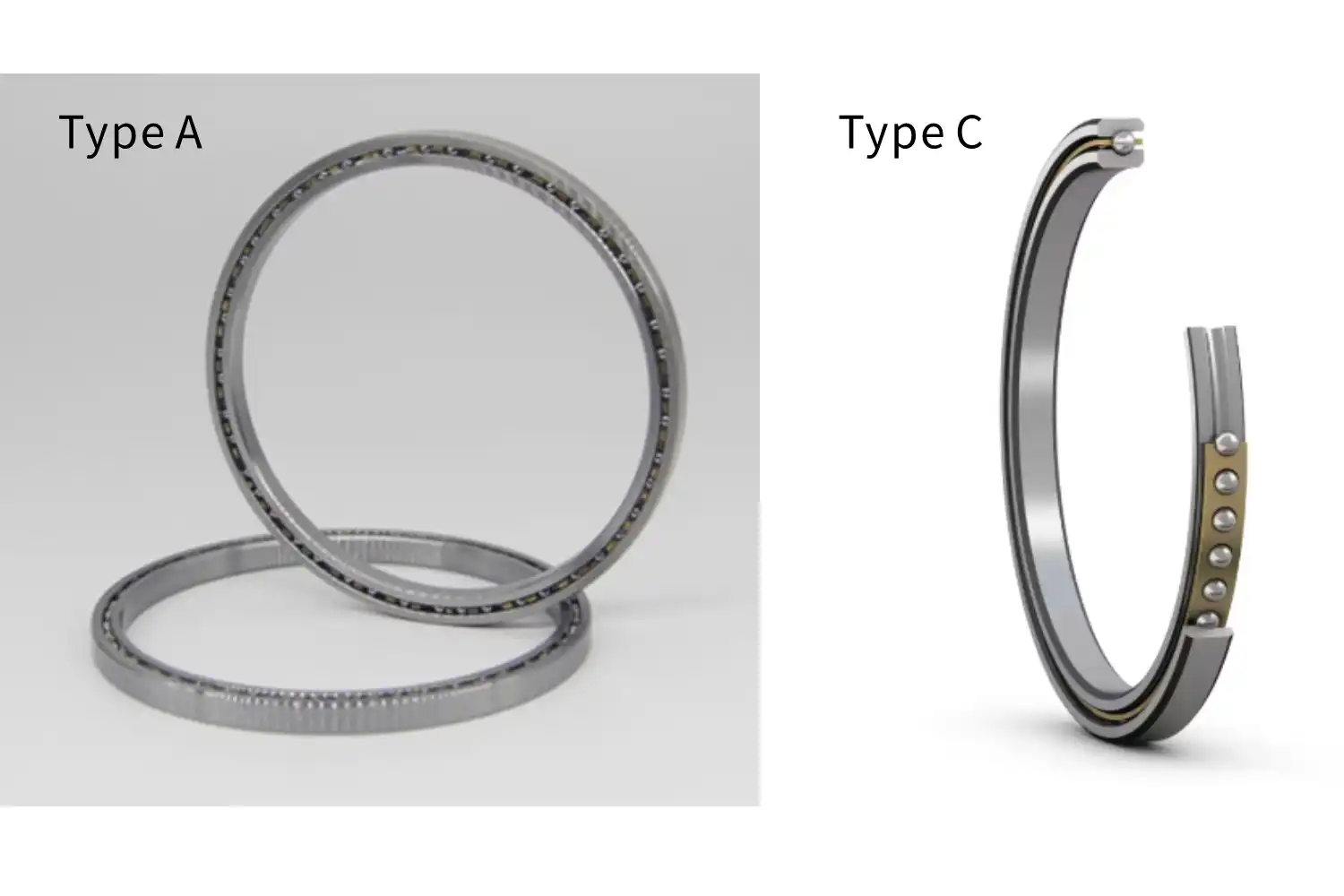
Understanding Type A Thin Section Bearing Fundamentals
Type A thin section bearings represent a specialized category of angular contact ball bearings engineered for applications demanding maximum space efficiency. These bearings maintain constant cross-sectional dimensions regardless of bore diameter, distinguishing them from standard angular contact bearings, where dimensions increase proportionally. The unique design philosophy centers around standardization across product lines. Engineers can utilize identical cross-sections throughout their designs, simplifying inventory management and reducing manufacturing complexity. This approach proves particularly valuable in industries requiring consistent component specifications. Key dimensional specifications for Type A configurations include:
- Bore diameters ranging from 1 inch to 40 inches
- Cross-sections from 0.1875 × 0.1875 inch to 1.000 × 1.000 inch
- Maintained proportions across all size variants
- Standardized mounting interfaces for simplified installation
If you need consistent component specifications across multiple machine sizes, Type A bearings provide unmatched standardization benefits.
Type C Thin Section Bearing Characteristics
Type C thin section bearings utilize radial contact ball configurations, optimized for applications handling primarily radial loads. Unlike their Type A Thin Section Bearing, these bearings excel in situations requiring maximum radial load capacity without significant axial loading concerns. The radial contact design allows for larger ball complements within the same envelope dimensions. This increased ball count translates directly into higher radial load ratings and improved load distribution characteristics. Manufacturing precision focuses on achieving minimal radial runout and exceptional rotational smoothness. Performance characteristics include:
- Superior radial load handling capabilities
- Lower friction coefficients in pure radial applications
- Enhanced rotational smoothness at moderate speeds
- Reduced axial space requirements compared to angular contact designs
If you need maximum radial load capacity in confined spaces, Type C bearings deliver superior performance for your application requirements.
Critical Performance Differences Analysis
The fundamental distinction between these bearing types lies in their contact angle configurations and resulting load handling capabilities. Real-world testing reveals significant performance variations across multiple parameters.Load capacity comparisons demonstrate clear advantages for each type:
Angular Load Performance:
Type A bearings handle combined radial and axial loads effectively. Test data from precision machinery applications shows 40% higher axial load ratings compared to Type C variants. The 15-25 degree contact angle provides optimal load distribution for complex loading scenarios.
Radial Load Performance:
Type C bearings excel in pure radial applications, delivering up to 30% higher radial load capacity. The radial contact design maximizes ball-to-raceway contact area, improving load distribution and bearing life expectancy.
Speed Capabilities:
Laboratory testing reveals that Type A Thin Section Bearing achieves higher operational speeds due to reduced ball skidding tendencies. Maximum speeds reach 15% higher values compared to Type C designs under equivalent loading conditions. Three core performance differences emerge:
- Contact angle variations affecting load distribution patterns
- Ball complement differences impacting capacity ratings
- Friction characteristics vary based on contact geometry
If you need versatile load handling with moderate speeds, Type A bearings offer superior flexibility for diverse operating conditions.
Application Suitability Comparison
Industry applications reveal distinct preferences based on operational requirements and performance priorities. Understanding these application-specific advantages guides proper bearing selection for optimal results.
Precision Machinery Applications:
Machine tool spindles frequently utilize Type A bearings due to their combined load handling capabilities. The angular contact design accommodates cutting forces while maintaining positional accuracy. Aerospace applications similarly benefit from the versatility of angular contact configurations.
Rotary Table Applications:
Type C bearings dominate rotary table applications where primary loads remain radial. The increased radial load capacity supports heavy workpieces while maintaining smooth rotation. Medical equipment often incorporates Type C designs for imaging systems requiring precise radial positioning.
Automation Equipment:
Robotic joints and automation systems present mixed requirements. Type A bearings suit applications with varying load directions, while Type C bearings excel in dedicated rotary mechanisms with consistent radial loading patterns. Environmental considerations also influence selection decisions:
- Temperature stability requirements favor specific contact geometries
- Contamination resistance varies between bearing types
- Maintenance accessibility affects long-term operational costs
- Replacement frequency impacts the total cost of ownership
If you need reliable performance in harsh industrial environments, consider your specific loading patterns and maintenance capabilities.
Installation and Maintenance Considerations
Proper installation procedures differ between Type A and Type C bearings due to their distinct design characteristics. Understanding these differences prevents premature failure and ensures optimal performance throughout the bearing lifecycle.
Type A Installation Requirements:
Angular contact bearings require careful attention to preload settings and angular positioning. Mounting procedures must account for the contact angle to achieve proper load distribution. Shaft and housing fit demand precise tolerances to prevent excessive preload or inadequate support.
Type C Installation Considerations:
Radial contact bearings simplify installation procedures but require attention to radial positioning accuracy. The installation process focuses on achieving proper radial clearances and preventing housing distortion that could affect ball-to-raceway contact patterns. Maintenance schedules vary based on bearing type and application severity:
- Type A bearings require monitoring of axial clearances and preload retention
- Type C bearings need regular radial runout measurements and vibration analysis
- Lubrication intervals depend on operating speeds and environmental conditions
Preventive maintenance protocols include:
- Regular temperature monitoring to detect developing problems
- Vibration analysis for early wear detection
- Lubrication analysis to determine relubrication intervals
- Visual inspections for contamination or damage indicators
If you need simplified maintenance procedures with reliable performance indicators, establish comprehensive monitoring protocols tailored to your specific bearing configuration.
Cost-Benefit Analysis for Industrial Applications
Economic considerations significantly influence bearing selection decisions, particularly in large-scale industrial applications. Total cost of ownership encompasses initial procurement costs, installation expenses, maintenance requirements, and replacement frequency.
Initial Investment Comparison:
Type A bearings typically command premium pricing due to their complex angular contact geometry and precision manufacturing requirements. Type C bearings offer more competitive initial costs while delivering excellent value in suitable applications.
Operational Cost Factors:
Maintenance intervals and replacement frequency significantly impact long-term costs. Type A Thin Section Bearing often provides extended service life in demanding applications, offsetting higher initial investments. Type C bearings excel in applications with predictable loading patterns and moderate duty cycles. Performance-based cost analysis reveals:
- Energy efficiency differences affecting operational costs
- Downtime reduction potential through proper bearing selection
- Inventory simplification benefits from standardized components
- Training requirements for maintenance personnel
Return on investment calculations must consider:
- Application-specific performance requirements and associated costs
- Maintenance complexity and labor requirements
- Expected service life under actual operating conditions
If you need optimized cost-performance ratios, evaluate total ownership costs rather than focusing solely on initial procurement expenses.
Conclusion
Selecting between Type A and Type C thin section bearings requires careful analysis of application requirements, loading characteristics, and operational priorities. Type A Thin Section Bearing excel in applications demanding combined load handling and versatility, while Type C bearings provide superior radial capacity for dedicated radial loading scenarios. Consider your specific performance requirements, maintenance capabilities, and total cost of ownership when making this critical decision. Proper bearing selection directly impacts equipment reliability, operational efficiency, and long-term maintenance costs.
Huigong's Type A Thin Section Bearing Manufacturing Excellence
Huigong stands as a premier Type A thin section bearing manufacturer, delivering precision-engineered solutions for demanding industrial applications. Our manufacturing capabilities span the complete range of thin section bearing configurations, with particular expertise in large-diameter precision bearings.
Huigong's Type A Thin Section Bearing Advantages:
- Advanced Manufacturing Technology: Our state-of-the-art production facilities feature over 150 sets of precision machinery, ensuring consistent quality and dimensional accuracy across all bearing sizes. Specialized grinding equipment maintains tolerances within 0.0001 inch for critical dimensions.
- Comprehensive Quality Control: More than 70 sets of testing equipment, including CMM, metallographic microscopes, and roundness meters, verify bearing performance. Each bearing undergoes rigorous inspection protocols before shipment to ensure reliability.
- Custom Engineering Solutions: Our technical team provides tailored bearing designs for specific application requirements. Custom cage materials, special coatings, and modified geometries address unique operational challenges.
- Material Excellence: High-grade bearing steels and advanced heat treatment processes deliver superior fatigue life and dimensional stability. Stainless steel variants provide corrosion resistance for harsh environments.
Our commitment to excellence extends beyond manufacturing to include comprehensive customer support and technical consultation. Whether you need standard Type A configurations or custom-engineered solutions, Huigong delivers reliable performance for your most demanding applications. When precision matters, and reliability cannot be compromised, Huigong's Type A thin section bearing solutions provide the performance foundation your operations demand. Contact us at sale@chg-bearing.com to discuss your specific requirements and discover how our expertise can optimize your machinery performance.
References
1. Harris, T.A., and Kotzalas, M.N. "Essential Concepts of Bearing Technology." CRC Press, 2007.
2. Hamrock, B.J., Schmid, S.R., and Jacobson, B.O. "Fundamentals of Fluid Film Lubrication." Marcel Dekker, 2004.
3. Jones, A.B. "A General Theory for Elastically Constrained Ball and Radial Roller Bearings." ASME Journal of Basic Engineering, 1960.
4. Eschmann, P., Hasbargen, L., and Weigand, K. "Ball and Roller Bearings: Theory, Design and Application." John Wiley & Sons, 1985.
5. Tallian, T.E. "Failure Atlas for Hertz Contact Machine Elements." ASME Press, 1999.
6. Burton, R.A. "Thermal Deformation in Frictionally Heated Contact." Wear, Vol. 59, 1980.