

Why Engineers Prefer Ru Cross Roller Bearings for Precision
When engineers make machine tools, artificial joints, and rotary tables, they always have to choose between being small, rigid, and able to rotate accurately. This problem can be solved by RU Cross Roller Bearings, which combine radial, axial, and bending moment support into a single, space-saving structure. This is why they are so popular in industries that need precision. Because they have crossed rollers, a combined ring design, and a usable setup, they can be used in places where even small amounts of runout or misalignment are not acceptable. What makes RU Cross Roller Bearings great for precise work? This piece talks about their structural benefits, how they improve stiffness and accuracy, and where engineers usually ask for them. These bearings feature integrated mounting holes that simplify assembly and reduce overall housing size. Their compact profile allows more design flexibility, especially in robotic joints and medical devices. Enhanced rigidity ensures stable performance under variable loads, making them indispensable for high-precision indexing and positioning operations.
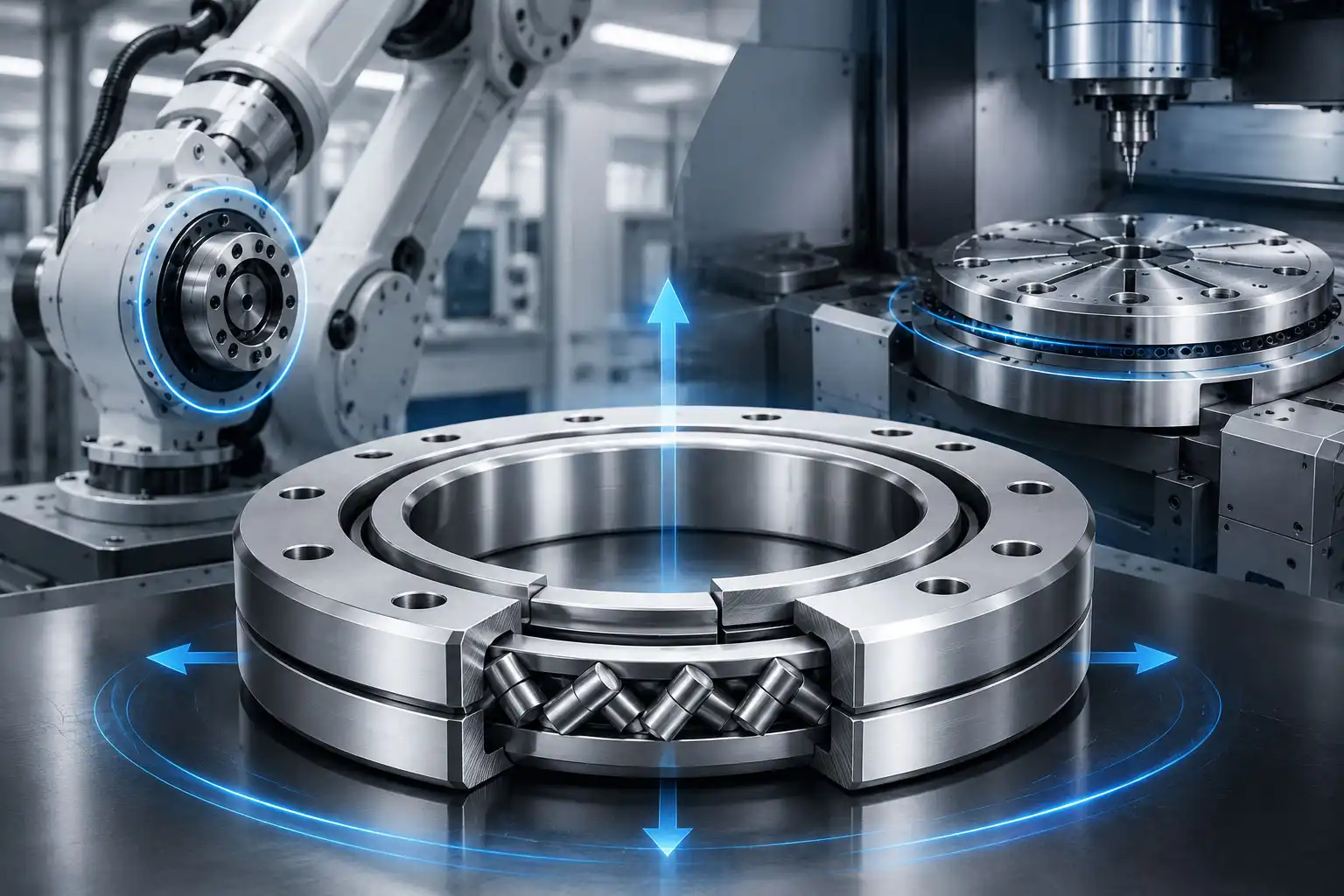
What Makes RU Cross Roller Bearings Ideal for High-Precision Engineering Applications?
Crossed Roller Design and Precision Grades
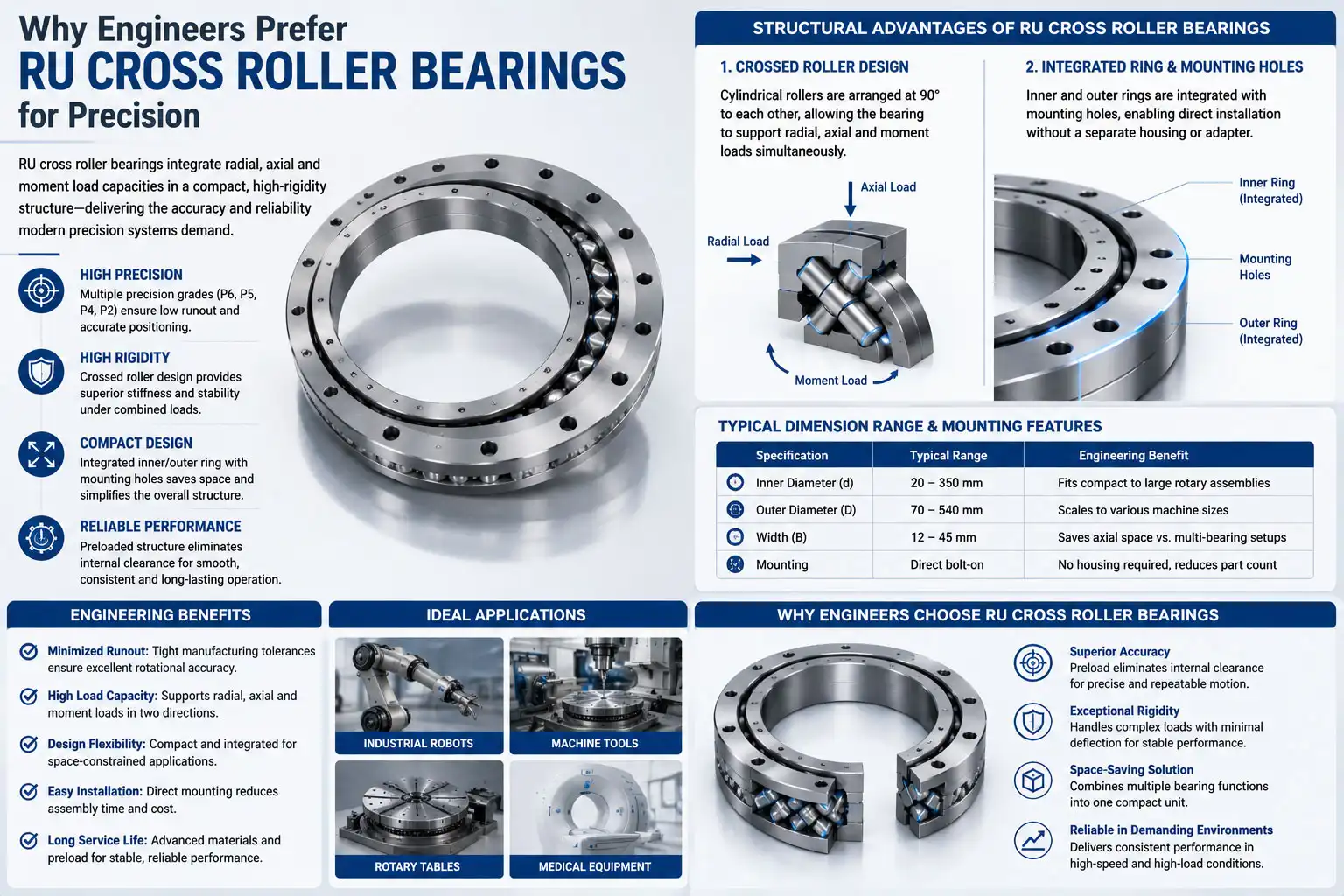
RU Cross Roller Bearings have a single track with crisscrossed cylinder rollers placed inside it. As the bearing turns, each roller supports loads in both the radial and axial directions. This design comes in a number of different precision grades, such as P6, P0, P5, P4, and P2. This gives engineers the freedom to choose the right level of accuracy for each machine. RU Cross Roller Bearings keep their tighter tolerances even when working conditions change because the crossed arrangement spreads the load more widely than straight roller rows. The alternating roller orientation eliminates slip and reduces friction, which enhances rotational smoothness. Additionally, the compact raceway design minimizes space requirements while supporting high moment loads. These characteristics make RU bearings particularly suitable for multi-axis machining centers and precision measuring instruments that demand consistent accuracy under varying operational demands.
Integrated Inner/Outer Ring Structure
Unlike other bearings that need a separate case or pressure plate, RU Cross Roller Bearings have fastening holes built right into the structure of the inner and outer rings. This lets engineers bolt the bearing directly onto machine parts that are close by, cutting down on the number of parts needed and making assembly easier. RU Cross Roller Bearings have more stable spinning accuracy and torque, even if the fitting is different, because performance relies less on how carefully the outside case is polished. The integrated mounting holes also reduce assembly time and simplify maintenance, as no additional clamping components are required. This design minimizes alignment errors and ensures consistent preload distribution, even in compact equipment layouts. For high-volume production environments, this feature significantly lowers installation costs and improves overall manufacturing efficiency without compromising operational precision.
Key Structural Advantages of RU Cross Roller Bearings for Enhanced Accuracy
Built-In Preload and Rigidity
Factory-applied preload, which reduces interior space between rollers and raceways before installation, is one of the main structural benefits of RU Cross Roller Bearings. This built-in tension makes the bearing stiffer overall, so it can withstand axial load, rotational load, and twisting moment all at the same time. This stiffness immediately leads to more accurate and repeatable placement across the full range of working loads for things like rotary stages and machine tool frames. The preload also minimizes deflection under heavy cutting forces, preserving surface finish quality in machining operations. It ensures consistent contact geometry, reducing wear and extending service life. As a result, RU bearings deliver reliable positioning even during rapid acceleration or deceleration, making them ideal for precision automation and measuring equipment.
Compact Size and Mounting Simplicity
Because RU Cross Roller Bearings carry more than one load in a single part, they take up a lot less room than similar multi-bearing systems. This is helpful in machines where every millimetre of horizontal height counts. The table below shows the usual ranges of dimensions and fastening features for this type. By reducing overall assembly height, these bearings enable more compact machine designs without sacrificing load capacity or rigidity. This space-saving advantage is especially valuable in robotics, medical devices, and aerospace applications where installation space is limited. Engineers can achieve higher performance in smaller footprints, allowing for lighter structures and improved system dynamics.
| Specification | Typical Range | Engineering Benefit |
|---|---|---|
| Inner diameter | 20-350 mm | Fits compact rotary assemblies |
| Outer diameter | 70-540 mm | Scales to various machine sizes |
| Width | 12-45 mm | Saves axial space versus multi-bearing setups |
| Mounting | Direct bolt-on, no housing required | Simplifies assembly, reduces part count |
How Do RU Cross Roller Bearings Improve Rigidity and Rotational Precision?
Handling Combined Loads with Minimal Runout
The crossing rollers in an RU Cross Roller Bearing can handle axial load, radial load, and bending moment in two directions. This means that they keep runout to a minimum even when loads from outside the bearing change direction. With this combined-load feature, you don't need separate thrust and rotational bearings, which would add to the stack-up limits and misalignment. This makes a unit that is smaller but still meets the strict runout standards of robots and precision machine tools. The integrated design also reduces the number of components required, simplifying supply chain management and lowering assembly costs. By eliminating multiple bearing arrangements, engineers achieve better concentricity and reduced cumulative tolerances, which directly enhances positioning repeatability. This compact, high-performance solution is ideal for applications requiring both space efficiency and exceptional rotational accuracy.
Stable Performance for Inner-Ring or Outer-Ring Rotation
RU Cross Roller Bearings can be set up to rotate either the inner ring or the outer ring. This gives engineers more options when they are making rotating tables, tracking units, and robotic joints. Because the combined structure and placement of washers in the bearing don't change much depending on which ring moves, performance is the same in both cases. Because they are flexible, the same line of RU Cross Roller Bearings can be used in a variety of mechanical setups without affecting their accuracy or torque stability. This design versatility simplifies inventory management, as a single bearing type serves multiple configurations. Engineers can standardize on one component across different product lines, reducing design complexity and procurement costs. Whether used in horizontal or vertical orientations, RU bearings deliver consistent rotational precision, making them a preferred choice for flexible automation systems.
Common Applications Where RU Cross Roller Bearings Are Preferred by Engineers
Industrial Robots and Machine Tools
CNC machines and industrial robots both need to be able to rotate precisely and consistently. This is why RU Cross Roller Bearings are often used in robotic joints, rotating axes, and spindle support systems. The table below shows how application needs usually match up with bearing capabilities. For high-speed machining centers, these bearings provide the stiffness required to maintain tight tolerances during heavy cuts. In robotic applications, their low friction and minimal runout enable smooth, repeatable motion cycles. By aligning bearing specifications with operational demands, engineers can optimize machine performance, extend component life, and reduce unexpected downtime in production environments.
| Application | Primary Requirement | Why RU Cross Roller Bearings Fit |
|---|---|---|
| Industrial robot joints | Low runout, compact size | Integrated ring saves space, maintains accuracy |
| CNC rotary tables | High rigidity, preload | Built-in preload resists deflection |
| Indexing units | Inner/outer-ring flexibility | Either ring can rotate without performance loss |
Heavy Equipment: Cranes and Excavators
Besides precision machinery, RU Cross Roller Bearings are also used in cranes and loaders because they can manage radial, axial, and moment loads together. This lets them keep rotating smoothly even when the loads are heavy and changeable. In these uses, load capacity is more important than micron-level accuracy. However, the same stiffness that helps machine tools also helps heavy equipment move more easily, which protects nearby parts from wear and tear and extends the equipment's useful life. The robust design minimizes shock transmission during sudden load changes, reducing stress on gearboxes and drive motors. This increased durability lowers maintenance frequency and operational costs for construction and material handling equipment. Their ability to handle harsh conditions makes RU bearings a reliable choice for both precision and heavy-duty applications.
Conclusion
Engineers can use RU Cross Roller Bearings to make small, rigid, and accurate parts for everything from robot joints to heavy building equipment. CHG Bearing was founded in 1998 and is based in Luoyang, China. Each bearing they make is backed by their decades of experience, state-of-the-art testing tools, and ISO-certified quality processes. CHG Bearing helps users all over the world get reliable, high-precision spinning performance. It has more than 50 patent ideas. Their engineering team provides comprehensive application support, helping customers select the optimal bearing for specific operating conditions. Advanced manufacturing techniques ensure consistent quality across large production runs. With a global service network and responsive technical assistance, CHG delivers dependable solutions that meet rigorous performance demands in both precision and heavy-duty industrial environments.
FAQ
What loads can RU Cross Roller Bearings support?
They support double-direction axial load, radial load, and tilting moment simultaneously within a single bearing.
Do these bearings require a separate housing?
No, the integrated inner/outer ring design includes mounting holes, eliminating the need for a housing or flange.
Can RU Cross Roller Bearings handle outer-ring rotation?
Yes, they can be configured for either inner-ring or outer-ring rotation without losing performance consistency.
What precision grades are available?
Common grades include P6, P0, P5, P4, and P2, allowing selection based on application accuracy needs.
Which industries commonly use this bearing type?
Industrial robotics, machine tools, cranes, and excavators all rely on RU Cross Roller Bearings for stable rotation.
Get Precision RU Cross Roller Bearings from CHG Bearing
If your project demands compact, rigid, and accurate rotational support, CHG Bearing's engineering team can recommend the right RU Cross Roller Bearings configuration for your machine. With 30 years of manufacturing experience and ISO-certified production, we deliver customized solutions for robotics, machine tools, and heavy equipment. Our experts evaluate your load requirements, speed profiles, and space constraints to determine the optimal bearing size and preload class. We also provide installation guidance and ongoing technical support to ensure seamless integration. Each bearing undergoes comprehensive quality checks, including dimensional verification and torque testing, guaranteeing reliable performance in your most demanding applications. Contact us today to discuss your specific needs. Contact us at sale@chg-bearing.com for a tailored recommendation built for long-term precision.
References
1. International Organization for Standardization, ISO 492: Rolling Bearings — Tolerances.
2. Harris, T. A., Kotzalas, M. N., Rolling Bearing Analysis, CRC Press.
3. Brändlein, J., Eschmann, P., Hasbargen, L., Weigand, K., Ball and Roller Bearings: Theory, Design and Application, John Wiley & Sons.
4. American Bearing Manufacturers Association, ABMA Standard 20: Radial Bearings of Ball, Cylindrical Roller, and Spherical Roller Types.
5. THK Co., Ltd., Cross Roller Ring engineering technical handbook.
6. International Organization for Standardization, ISO 15: Rolling Bearings — Radial Bearings — Boundary Dimensions.