

How to Select the Right Single Row Ball Slewing Bearing?
Choosing the right spinning support part can make the difference between a machine that works well for decades and one that breaks down early. A Single Row Ball Slewing Bearing is commonly used for machines that need to turn while handling axial, radial, and moment loads at the same time. It is often used in cranes, building equipment, and wind mills because it is small and evenly distributes weight. This guide talks about how the bearing works, its most important design features, how to test its load and accuracy, and how to choose the right bearing for your needs. Proper selection considers operating conditions, expected duty cycles, environmental factors like temperature and contamination, and maintenance access, all of which directly affect service life and reliability. Understanding these parameters helps engineers match the bearing to the specific performance demands of each application.
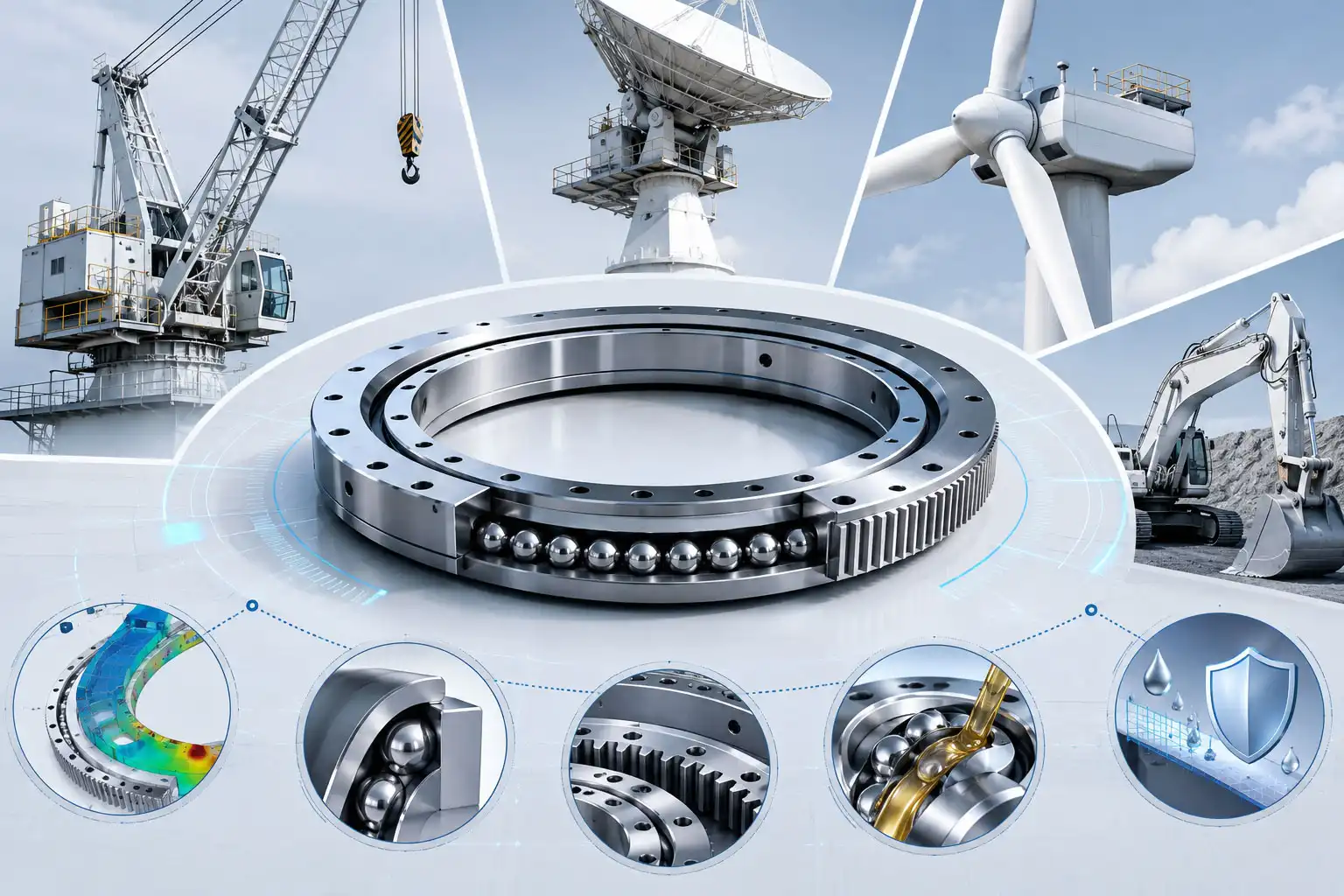
What Is a Single Row Ball Slewing Bearing and How Does It Work?
Basic Structure and Working Principle
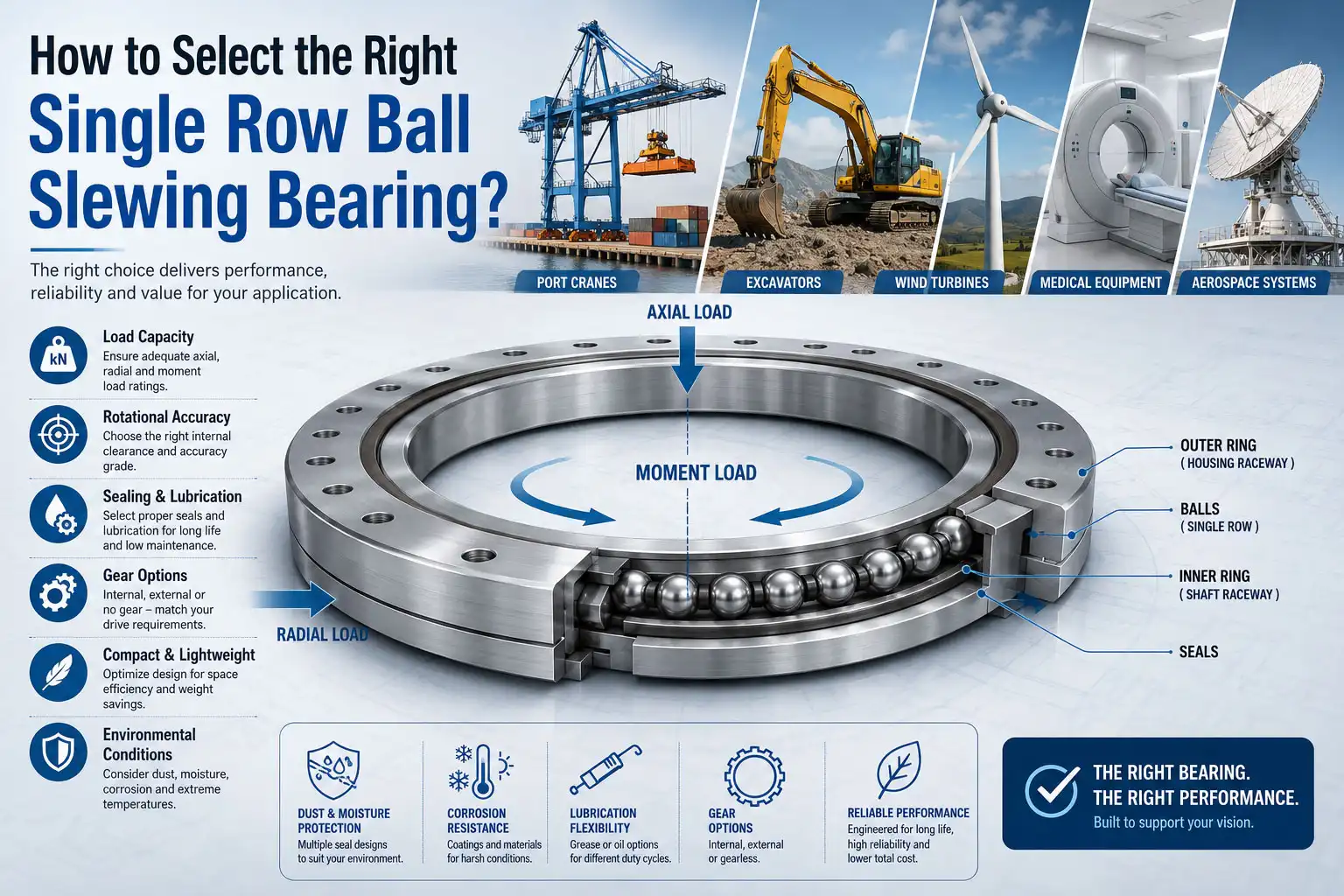
An inner ring, an outer ring, and a row of steel balls between two raceways make up a Single Row Ball Slewing Bearing. The balls hold the spinning unit in place. In contrast to designs with multiple rows, this one only needs one row of balls to support the whole load, which keeps the cross-section small and the weight low. The Single Row Ball Slewing Bearing can spin with little friction even when it has to handle heavy loads because the raceway contact angles spread the axial, radial, and turning forces equally across the balls. This balanced force distribution reduces stress concentration, minimises wear over time, and ensures smooth rotation under demanding operating conditions.
Core Functions in Rotating Machinery
One Row Ball Slewing Bearings main job is to allow two structural parts to move around each other while transmitting axial force, radial force, and toppling moment. This gets rid of the need for separate thrust and rotary bearings, which makes designing machines easier. Tower cranes and spinning tables count on this bearing to keep the turn smooth, cut down on mechanical play, and keep the position stable over and over again. The bearing's compact design also simplifies maintenance access, reduces overall assembly height, and lowers material costs. In heavy-duty applications such as excavators and aerial work platforms, this single-component solution delivers dependable performance while minimising the number of parts that require regular inspection and replacement.
Key Design Features of Single Row Ball Slewing Bearing for Optimal Performance
Compact and Lightweight Construction
One great thing about a Single Row Ball Slewing Bearing is that it is thin and takes up little room. The bearing takes up less space along its axis than two- or three-row options because it only has one row of balls. This makes the machine lighter without affecting its ability to rotate steadily. This small size is useful for mobile equipment, flight systems, and entertainment rides where extra weight can increase fuel use, make structures heavier, or make movement more difficult. By reducing overall system mass, designers can use smaller support frames, lower drive power requirements, and improve energy efficiency. These savings become especially significant in large-scale productions or fleet operations where every kilogram directly affects operating costs and performance.
Sealing, Lubrication, and Gear Options
A well-made Single Row Ball Slewing Bearing has more than just the track. It also has good seals to keep out dust, water, and other debris, and lubricant lines that keep the ball in touch with the raceway over long periods of time. A lot of them also have gear teeth on the inside or outside for straight pinion drive. These features are just as important as load grade because they add to the service life of the bearings. They include mounting holes, strengthened raceways, and coverings that fight rust. Proper seal design prevents contamination ingress even in harsh environments like construction sites or offshore platforms, while reliable lubrication channels reduce friction and heat generation. Corrosion-resistant coatings further protect against moisture and chemicals, ensuring consistent performance over decades of service with minimal maintenance intervention.
How to Evaluate Load Capacity and Rotational Accuracy Requirements?
Calculating Axial, Radial, and Moment Loads
Engineers need to know the exact static and dynamic axial load, radial load, and rolling moment for a Single Row Ball Slewing Bearing before they can choose one. These numbers should include peak loads from wind, contact, or quick stops. Load-life curves and steady capacity charts are usually given by manufacturers so that buyers can make sure they have a safety gap instead of going close to the stated limit. Underestimating the total load is a typical reason why raceways wear out too quickly and bearings break. Operating conditions such as shock loading, vibration, and temperature extremes must also be factored into calculations, as these variables significantly reduce effective load capacity. A thorough load analysis, combined with proper safety margins, ensures reliable long-term operation and prevents unexpected downtime.
Assessing Precision and Rotational Accuracy Needs
Rotational accuracy is just as important as raw load capacity when it comes to equipment that needs to be positioned precisely, like medical imaging devices or flight platforms. For precise jobs, a Single Row Ball Slewing Bearing should list its runout tolerances, friction torque consistency, and clearance class. This is because tighter tolerances cause shaking and positioning errors. Standard accuracy classes are usually enough for lower-precision uses like building tools, making the choice more cost-effective. For high-end applications, however, special grinding and selected ball grades can achieve sub-millimetre positioning stability, while still maintaining smooth motion. Balancing accuracy with cost ensures the bearing meets performance needs without over-engineering for less demanding environments.
Single Row Ball Slewing Bearing Selection Criteria for Different Applications
Matching Bearing Type to Industry Application
There are different needs for a Single Row Ball Slewing Bearing in different fields, so it's important to match the standard to the use case. The flexible spinning of this bearing is good for high-frequency, low-load equipment like port tower cranes. However, very big lifting equipment may need a higher-capacity option. The table below shows what most applications need for the first round of selection. It also highlights key parameters such as load magnitude, rotation speed, and environmental factors, helping engineers quickly narrow down suitable models. This structured approach streamlines the selection process and reduces the risk of overlooking critical performance requirements.
| Application | Typical Load Profile | Rotation Frequency | Suggested Priority |
|---|---|---|---|
| Tower cranes, port equipment | Moderate axial/moment load | High | Smooth rotation, fatigue life |
| Excavators, loaders | High combined load | Medium | Load capacity, sealing |
| Wind turbines | Variable moment load | Low to medium | Fatigue resistance, sealing |
| Medical and aerospace devices | Light load | Variable | Rotational accuracy |
| Amusement rides | Light to moderate load | High | Smooth rotation, safety margin |
Environmental and Operating Condition Considerations
When choosing a Single Row Ball Slewing Bearing, the operating climate should be given a lot of thought. This is because high temperatures, humidity, dust, and rust can all change the seal material, lube choice, and covering needs. Offshore wind farms and seaports need better rust protection, but hospital or processing equipment inside can use the same methods. Reviewing the bearing's repair access, planned service interval, and customisation choices can help make sure it works well for a long time. Extreme cold conditions may require special low-temperature greases and enhanced seals to prevent cracking, while desert environments demand robust dust exclusion features. Matching the bearing's protective features to the actual site conditions prevents premature failures and reduces total lifecycle costs.
Conclusion
To pick the best Single Row Ball Slewing Bearing, you need to know about the working surroundings, the load conditions, and the level of accuracy you need. CHG Bearing was founded in 1998 and is based in Luoyang, China. They have decades of experience making things, current testing tools, and the ability to make tens of thousands of bearing sets every year. With more than 50 idea patents and quality systems that are ISO-certified, CHG Bearing helps customers all over the world turn careful technical evaluation into reliable, long-lasting performance for spinning equipment. Their engineering team provides customised design support and rapid prototyping services, ensuring each bearing matches unique application requirements. This comprehensive approach, from initial consultation to after-sales support, guarantees optimal performance and maximum service life for every project.
FAQ
What loads can a Single Row Ball Slewing Bearing support?
Axial, radial, and moment loads simultaneously, though its capacity is generally lower than multi-row roller slewing bearings.
Which industries commonly use this bearing type?
Construction machinery, tower cranes, wind turbines, drilling rigs, port terminals, agricultural machinery, and aerospace systems.
How do I know if rotational accuracy matters for my equipment?
If your application involves precise positioning, such as imaging or aerospace platforms, accuracy should take priority over raw load capacity.
Can the bearing be customised for specific working conditions?
Yes, manufacturers such as CHG Bearing offer tailored sealing, lubrication, gear, and coating options for different environments.
What maintenance does a Single Row Ball Slewing Bearing require?
Regular lubrication, periodic seal and fastener inspection, and torque checks help maintain smooth rotation and long service life.
Ready to Choose Your Single Row Ball Slewing Bearing?
If your equipment needs a reliable, precisely engineered rotating support solution, CHG Bearing's technical team is ready to help with a Single Row Ball Slewing Bearing. From load calculations to custom sealing and gear configurations, our 30 years of manufacturing experience and ISO-certified production stand behind every bearing we supply. Reach out today at sale@chg-bearing.com to discuss your requirements and get a tailored recommendation that keeps your machinery running smoothly.
References
1. International Organisation for Standardisation, ISO 21494: Earth-moving Machinery — Slewing Bearings — Specifications.
2. Harris, T. A., Kotzalas, M. N., Rolling Bearing Analysis, CRC Press.
3. Brändlein, J., Eschmann, P., Hasbargen, L., Weigand, K., Ball and Roller Bearings: Theory, Design and Application, John Wiley & Sons.
4. SKF Group, Slewing Bearings Engineering Handbook, SKF Publications.
5. Deutsches Institut für Normung, DIN 616: Rolling Bearings — Boundary Dimensions.
6. American Gear Manufacturers Association, AGMA 938-A: Slewing Bearing Application and Selection Guidelines.