

How Are XSU Cross Roller Bearings Preloaded for Accuracy?
Robotics, flight systems, and precision machinery all depend on spinning parts that don't move with any play or feedback that can be measured. This is possible with XSU Cross Roller Bearings because they remove the interior space between the rollers and raceways during the manufacturing process, before the bearing is used for its intended purpose. Because these bearings have an inner and outer ring that are one piece, as well as circular rollers that are set at right angles to each other, the preload directly affects how sturdy and accurate the system will be when both loads are applied. This piece talks about what "preload" for XSU Cross Roller Bearings means, how it's done, how it improves stiffness and accuracy, and what effects performance afterward. Proper preload selection ensures consistent torque, eliminates backlash, and extends service life, making these bearings indispensable for high-precision indexing tables, medical imaging equipment, and robotic arm joints where repeatability is paramount.
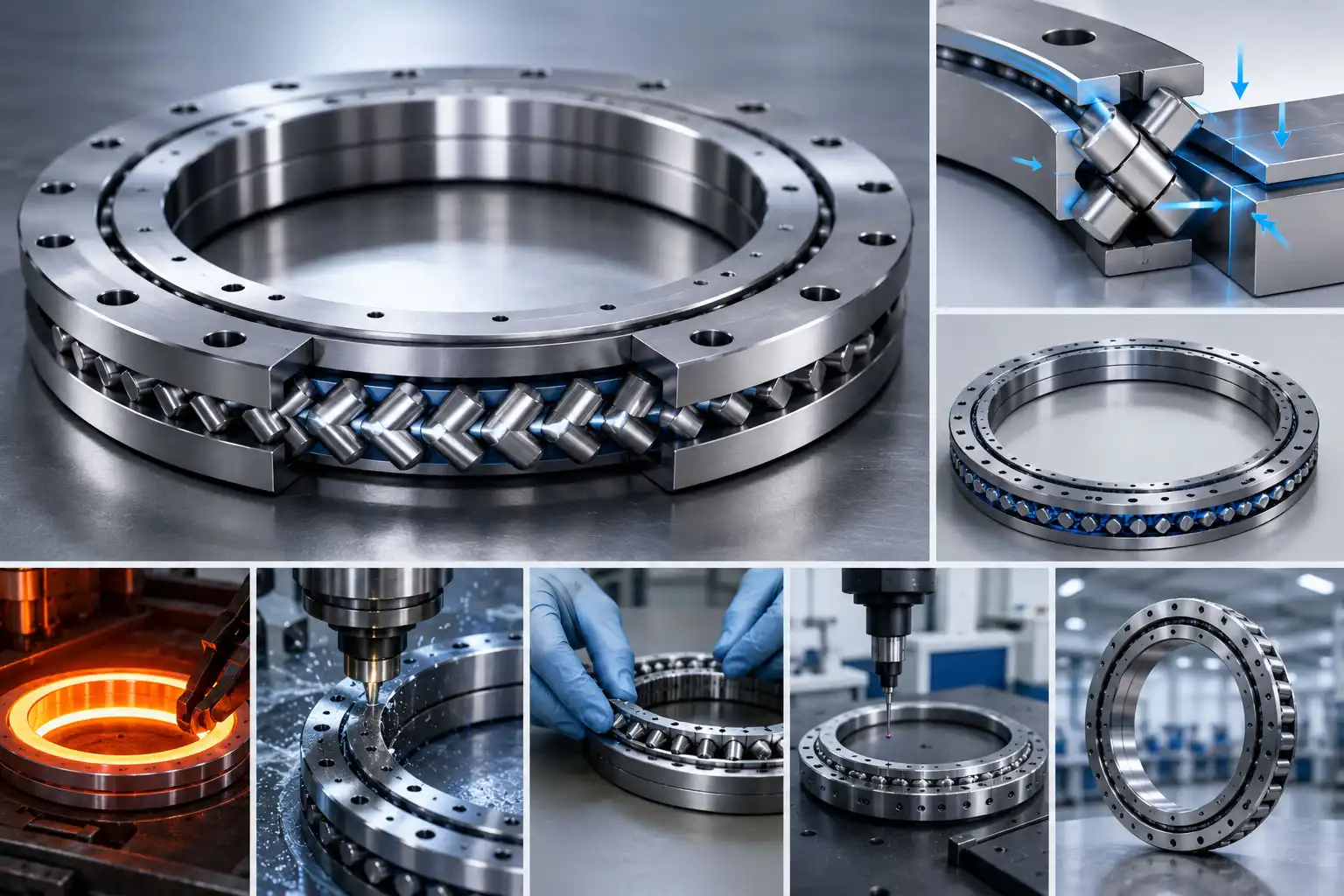
What Is Preload in XSU Cross Roller Bearings and Why Does It Matter?
Defining Preload in Crossed Roller Design
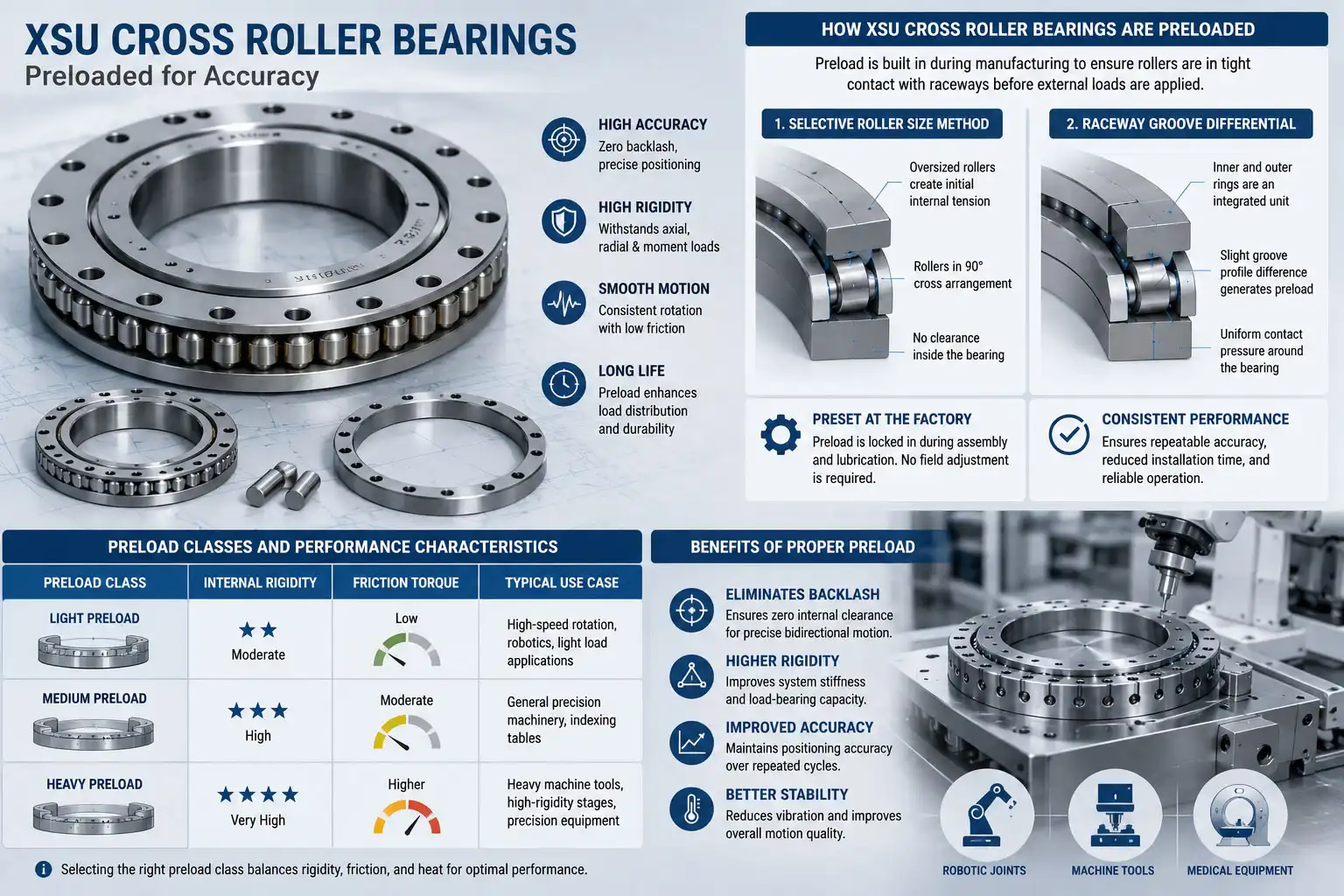
Preload is a controlled force that is put on the rolling elements while they are being made. This keeps the rollers in tight touch with both raceways before an outside load is put on them. For XSU Cross Roller Bearings, this is done by choosing rollers that are a little too big or by changing the raceway shape while they are being put together, since the inner and outer rings are already one piece. This built-in tension gets rid of small gaps inside that would otherwise let tiny movements happen, which is important for accurate, repeated placement. The preload also enhances load distribution across all rollers, minimizing stress concentrations that cause premature wear. Additionally, it maintains consistent contact geometry under varying operating temperatures, ensuring stable stiffness throughout the bearing's service life. These characteristics make preload essential for achieving sub-micron positioning accuracy in demanding automation applications.
Why Preload Is Essential for Precision Applications
Even a high-quality bearing can have visible play if it doesn't have the right preload. This can cause positioning errors, vibrations, and uneven load distribution. Robot joints, machine tool shafts, and medical imaging equipment often use XSU Cross Roller Bearings. A few microns of space can affect the quality of the product. Using the right setup makes sure that the rollers share the load fairly from the start, which helps businesses that need accuracy. In precision applications like semiconductor manufacturing or optical inspection systems, even minor deviations can lead to scrap parts or faulty measurements. Proper preload eliminates backlash and ensures consistent motion control, enabling faster cycle times and higher throughput without sacrificing dimensional accuracy or surface finish quality.
Preloading Methods Used in XSU Cross Roller Bearings for High Precision
Light, Medium, and Heavy Preload Classes
Most manufacturers of XSU Cross Roller Bearings offer more than one preload class. This lets engineers find the best mix between stiffness, friction, and heat generation based on the application. Lighter preload is best for high-speed, low-load tasks, while higher preload is only used for tasks that need the most strength, like big machine tool wheels. The table below shows a general overview of how these groups relate. Selecting the appropriate preload class requires balancing operational speed with required rigidity, as excessive preload can increase operating temperatures and reduce bearing life. Conversely, insufficient preload compromises accuracy and stability. Understanding these trade-offs helps design engineers make informed decisions that optimize performance while preventing premature maintenance issues.
| Preload Class | Internal Rigidity | Friction Torque | Typical Use Case |
|---|---|---|---|
| Light preload | Moderate | Low | High-speed rotation, robotics |
| Medium preload | High | Moderate | General precision machinery |
| Heavy preload | Very high | Higher | Heavy machine tools, high-rigidity stages |
Manufacturing Techniques for Achieving Preload
In XSU Cross Roller Bearings, preload is usually set by selective roller size, which matches the rollers to the exact dimensions of the raceways to create a set internal force that doesn't need to be adjusted from the outside. Some versions use a small difference in the shape of the raceway grooves to make the contact pressure the same all the way around. The preload is locked in firmly because the bearing is covered on both sides and greased during assembly. This makes installation easier because there is no need to make any adjustments in the field. Factory-preset preload eliminates the risk of human error during mounting, ensuring consistent performance across multiple units. It also reduces assembly time significantly, allowing equipment manufacturers to streamline their production processes. This design feature is especially valuable in high-volume manufacturing environments where repeatability and efficiency are critical to meeting quality standards.
How Does Proper Preload Improve Accuracy and Rigidity in XSU Cross Roller Bearings?
Eliminating Internal Clearance and Backlash
When you pre-load XSU Cross Roller Bearings, you get rid of the interior space that would let backlash happen when you change directions. This is important for robotic arms and motion joints, where moving forward and backward over and over again would cause the setting to become off if there was a break. Preload makes sure that the bearing reacts quickly and accurately to pressure by keeping all of the rollers in touch with the track. This continuous contact also dampens vibration and minimizes settling time after each movement, enabling faster and more precise positioning cycles. In high-speed pick-and-place operations, this responsiveness directly translates to improved throughput and reduced positional errors, making preload indispensable for advanced automation systems.
Enhancing Rigidity Under Combined Loads
Because XSU Cross Roller Bearings support radial, axial, and moment loads all at the same time through a single row of crossed rollers, they must stay rigid when all three types of loads are applied. When the preload is right, there are more rollers constantly sharing the load at all times. This keeps the rotating axis fixed even when forces change. This stability is useful in machine tool feed systems, where stiffness has a direct effect on how precise the finished piece is. In grinding and milling operations, any deflection in the bearing can result in dimensional inaccuracies or poor surface finishes. Consistent rigidity ensures that cutting tools maintain their intended path, reducing scrap rates and improving overall manufacturing quality. Preload thus becomes a critical factor for achieving tight tolerances in metalworking processes.
Factors Affecting Performance After Preloading XSU Cross Roller Bearings
Accuracy Grades and Their Impact
The final performance of an XSU Cross Roller Bearing depends on both the preload and the grade of measurement accuracy. These bearings come in several standard grades. Higher grades are more accurate and have less runout, but they cost more to make, so choosing the right grade saves money. In the table below, you can see typical accuracy scores and how well they usually perform. Selecting a grade that matches your application's precision requirements avoids unnecessary expenses while ensuring satisfactory performance. For general automation tasks, standard grades may suffice, whereas optical or semiconductor equipment often demand the highest accuracy levels. Balancing cost against accuracy helps optimize overall system value without compromising critical performance parameters.
| Accuracy Grade | Relative Precision | Typical Application |
|---|---|---|
| P0 | Standard | General industrial machinery |
| P6 | Improved | Standard precision equipment |
| P5 | High | Machine tools, robotics |
| P4 | Very high | High-precision spindles |
| P2 | Highest | Aerospace, semiconductor equipment |
Operating Conditions: Temperature, Speed, and Mounting
Operating temperature, rolling speed, and mounting stiffness can all change how well XSU Cross Roller Bearings work, even if they are properly primed. When the temperature goes up, the material expands, which can change the effective loading. On the other hand, going too fast can make the lube hot, which can affect its performance and accuracy. Since these bearings are made to be directly screwed onto neighbouring parts, making sure the mounting structure is strong helps keep the intended preload over time. Inconsistent housing rigidity may allow micro-deflections that reduce preload effectiveness. Similarly, rapid thermal cycling can alter clearances, affecting repeatability. Engineers must consider these variables during system design to maintain stable preload and achieve consistent accuracy throughout the bearing's operational life.
Conclusion
The preloading process is a key part of how XSU Cross Roller Bearings provide the stiffness, precision, and load capability that robots, machine tools, and aircraft systems need. CHG Bearing was founded in 1998 and is based in Luoyang, China. They make exactly preloaded crossed roller bearings using their many years of manufacturing experience, state-of-the-art testing tools, and ISO-certified quality systems. CHG Bearing helps users all over the world get reliable, high-precision spinning performance. It has more than 50 idea patents. Their engineering team collaborates closely with customers to customize preload levels for specific applications, ensuring optimal performance under unique operating conditions. Advanced measuring equipment verifies each bearing's dimensional accuracy and preload consistency, guaranteeing repeatable quality from batch to batch. With responsive technical support and global distribution, CHG ensures that precision-driven industries receive components that meet their most demanding specifications.
FAQ
What does preload do in XSU Cross Roller Bearings?
It removes internal clearance between rollers and raceways, improving rigidity and eliminating backlash.
Which preload class suits high-speed applications?
Light preload generally suits high-speed rotation, since it reduces friction torque and heat generation.
How do accuracy grades relate to preload?
Grades like P6, P5, P4, and P2 work alongside preload to determine overall rotational precision and runout.
Can preload change after installation?
Yes, temperature, speed, and mounting rigidity can affect preload over time, so rigid mounting is recommended.
What industries commonly use these bearings?
Robotics, aerospace, machine tools, medical equipment, and semiconductor manufacturing all rely on crossed roller bearing precision.
Get Precision-Preloaded XSU Cross Roller Bearings from CHG
If your application demands accurate, rigid rotational performance, CHG Bearing's engineering team can recommend the right preload class and accuracy grade for your needs. With 30 years of manufacturing experience and ISO-certified production, we deliver customized XSU Cross Roller Bearings for robotics, machine tools, and aerospace systems. Our experts analyze your load conditions, speed requirements, and thermal environment to select the optimal preload setting. We also provide detailed mounting instructions and technical documentation to simplify integration. Each bearing undergoes rigorous final inspection, including torque measurement and runout testing, to ensure it meets your exact specifications before delivery. Contact our team today to discuss your project requirements. Contact us today at sale@chg-bearing.com for a tailored recommendation built for long-term precision.
References
1. International Organization for Standardization, ISO 492: Rolling Bearings — Tolerances.
2. Harris, T. A., Kotzalas, M. N., Rolling Bearing Analysis, CRC Press.
3. Brändlein, J., Eschmann, P., Hasbargen, L., Weigand, K., Ball and Roller Bearings: Theory, Design and Application, John Wiley & Sons.
4. American Bearing Manufacturers Association, ABMA Standard 20: Radial Bearings of Ball, Cylindrical Roller, and Spherical Roller Types.
5. SKF Group, Crossed Roller Bearings Engineering Handbook, SKF Publications.
6. International Organization for Standardization, ISO 15: Rolling Bearings — Radial Bearings — Boundary Dimensions.