

Single Row Tapered Roller Bearings: Radial & Axial Load Experts
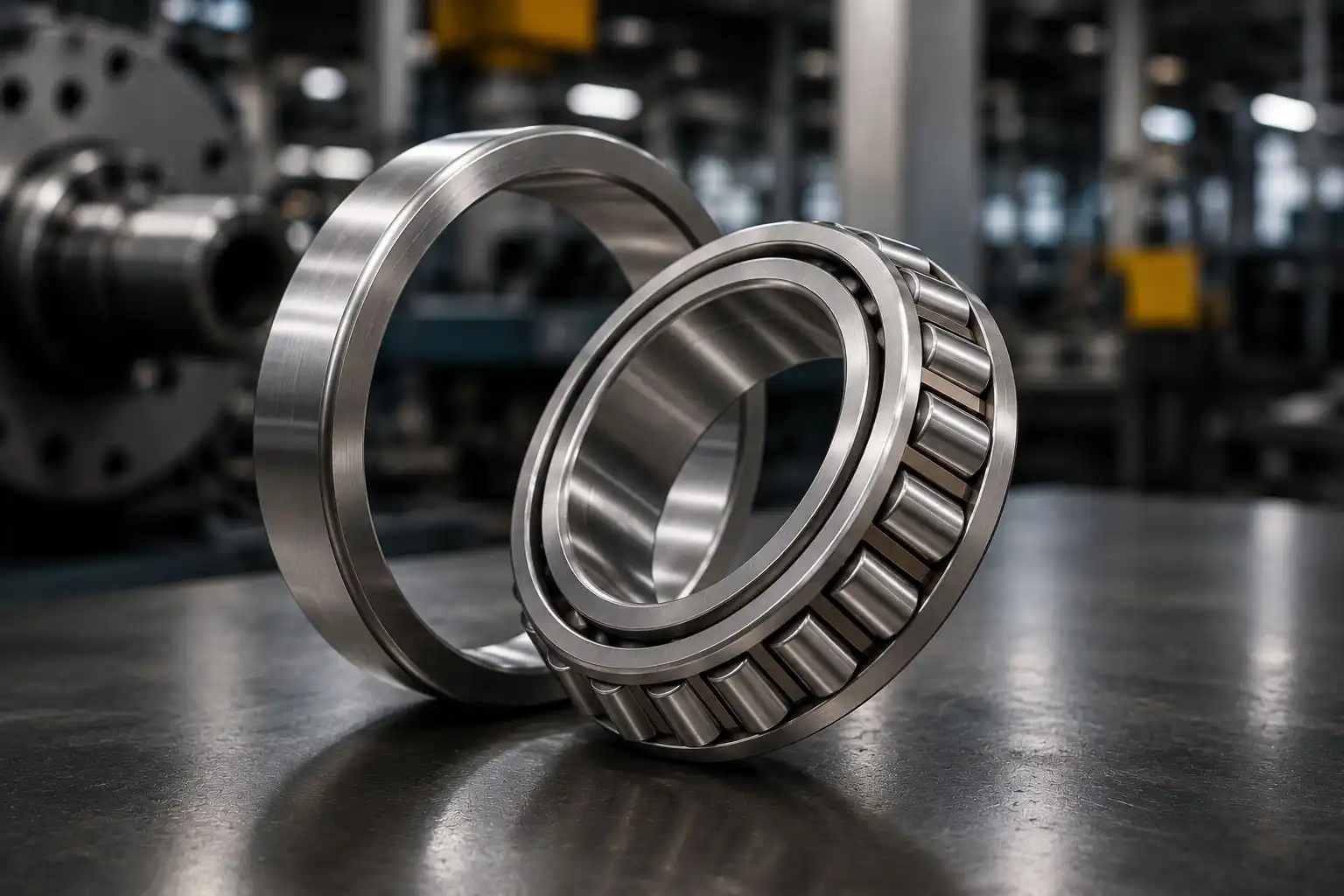
When it comes to handling both radial and axial loads within a single, compact component, few solutions match the engineering efficiency of the Single Row Tapered Roller Bearing. Widely used across automotive, industrial, and heavy machinery sectors, this bearing type combines precision geometry with robust load-carrying capability. Whether you are designing a new machine or sourcing replacement components, understanding the strengths, selection criteria, and maintenance requirements of the Single Row Tapered Roller Bearing will help you make a more informed decision — and keep your equipment running reliably for years to come.
What Are the Primary Applications of Single Row Tapered Roller Bearings?
Automotive Rear Axle Hubs and Wheel Assemblies
The Single Row Tapered Roller Bearing is used a lot in the car business for wheel hubs and rear axles. In these situations, the bearing has to handle both the weight of the car (which acts as a radial load) and the pressure from the corners (which act as an axial load). This mixture works well with the curved roller shape, which gives stable support during acceleration, stopping, and turning. Single Row Tapered Roller Bearings from CHG Bearing have inner sizes that range from 150 mm to 950 mm. This means that they can be used on wheels for both passenger cars and big industrial transport.
Machine Tool Spindles and Power Reducers
The Single Row Tapered Roller Bearing gives large machine tool spindles the precision and stability they need. In milling machines, drill mills, and turning centers, the bearing has to keep the dimensions within tight ranges even when the cutting force changes, while still letting the machine spin smoothly and without any vibrations. In the same way, single-row tapered roller bearings keep the combined gear-mesh radial forces and helical gear axial thrust going for long periods of time without needing to be replaced or adjusted often. These bearings are found in cement plants, steel mills, and paper processing lines.
Mining, Metallurgical, and Construction Equipment
The Single Row Tapered Roller Bearing is useful in some of the harshest settings in the world. It is used in jaw crushers and rotating screens in mining, and it is used in blast furnace parts in steelmaking. The Single Row Tapered Roller Bearing can handle mostly radial combined loads and mostly axial combined loads in big taper angle variants (27° to 30°). This lets engineers choose the best design for each given force environment. In building equipment, these single-row tapered roller bearings support heavy structural parts and ground-engaging tools that have to be reliable and not need to be serviced for a long time.
Understanding Radial and Axial Load Capabilities
Standard Taper Angle: Predominantly Radial Load Applications
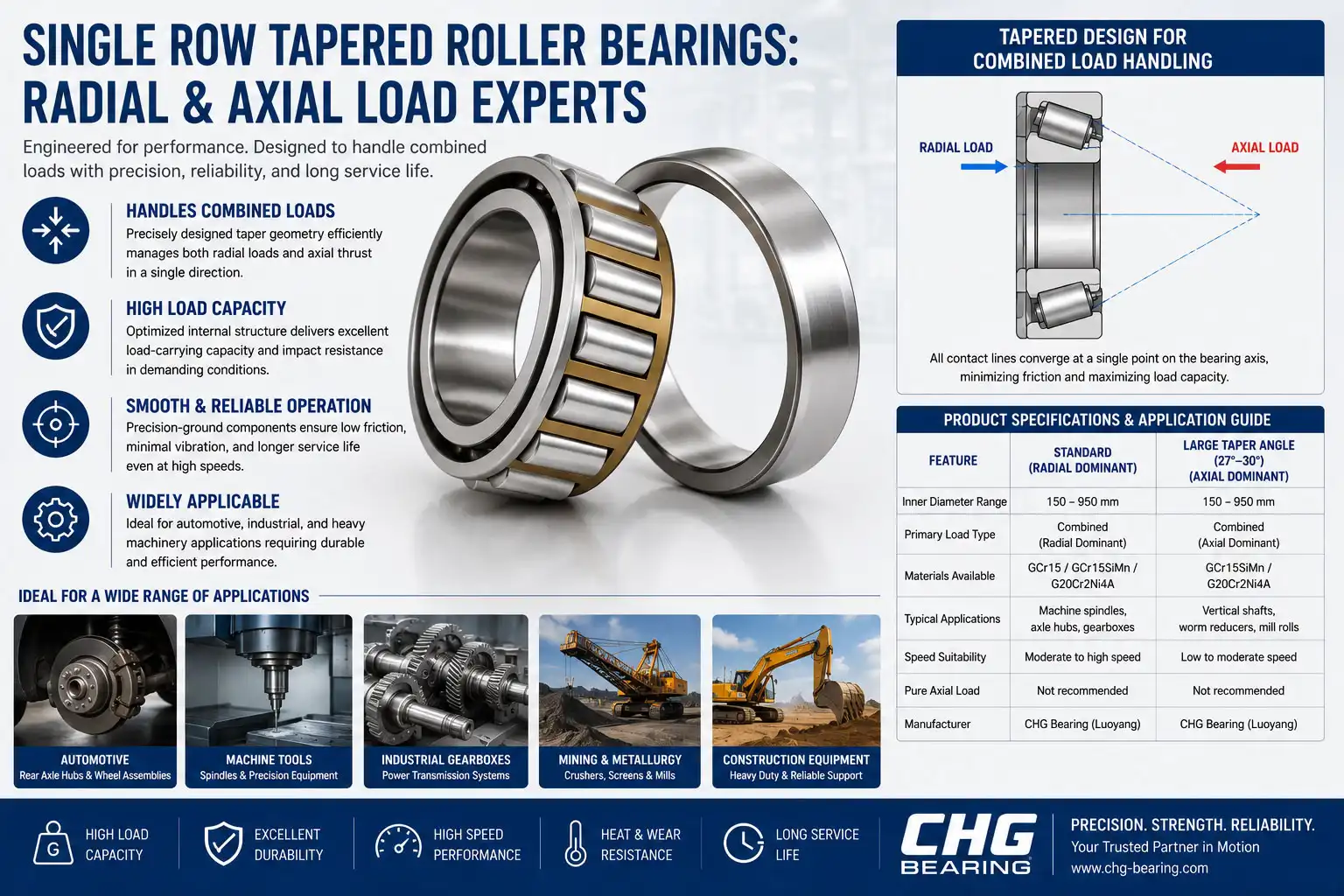
The standard Single Row Tapered Roller Bearing is optimized for applications where radial loads are the primary concern, with axial loads acting as secondary forces. The tapered roller and raceway geometry creates a contact angle that efficiently channels radial forces through the rolling elements to the outer ring, while the inherent geometry of the taper also reacts to axial thrust without requiring a separate thrust bearing. This makes the standard configuration ideal for feedway roller wheels, conveyor drives, and general industrial gearboxes where radial loading clearly dominates the force spectrum.
Large Taper Angle Variants: Predominantly Axial Load Applications
When axial forces become the dominant load — though pure axial loading is generally handled by dedicated thrust bearings — a Single Row Tapered Roller Bearing with a large taper angle of 27° to 30° provides significantly enhanced axial load capacity compared to standard configurations. These variants are particularly useful in applications such as vertical shaft assemblies, worm gear reducers, and certain rolling mill roll neck arrangements where the process generates substantial thrust that must be reliably absorbed. CHG Bearing's material options, including GCr15SiMn and G20Cr2Ni4A, further enhance fatigue resistance under these demanding axial-dominant load conditions.
Combined Load Capacity: Why Geometry Matters
The fundamental reason the Single Row Tapered Roller Bearing handles combined loads so effectively lies in its geometry. The rolling elements, raceways, and the bearing axis of the Single Row Tapered Roller Bearing all converge at a single apex point. This means the contact forces are directed along lines that intersect at this common point, eliminating the harmful sliding and differential slipping that would occur with non-tapered geometry. The result is lower heat generation, reduced energy consumption, and extended service life — even when load direction and magnitude fluctuate throughout the operating cycle, as is common in real-world machinery using a Single Row Tapered Roller Bearing.
Table: CHG Single Row Tapered Roller Bearing — Product Specifications & Application Guide
Specification / Feature | Standard Configuration | Large Taper Angle (27°–30°) |
Inner Diameter Range | 150 – 950 mm | 150 – 950 mm |
Primary Load Type | Combined (radial dominant) | Combined (axial dominant) |
Materials Available | GCr15 / GCr15SiMn / G20Cr2Ni4A | GCr15SiMn / G20Cr2Ni4A |
Typical Applications | Machine spindles, axle hubs, gearboxes | Vertical shafts, worm reducers, mill rolls |
Speed Suitability | Moderate to high speed | Low to moderate speed |
Pure Axial Load | Not recommended | Not recommended |
Manufacturer | CHG Bearing (Luoyang) | CHG Bearing (Luoyang) |
How to Select the Right Single Row Tapered Roller Bearing for Your Machinery?
Determining the Correct Size and Load Rating
Proper bearing selection begins with accurately characterizing the loads your application generates. Calculate both the equivalent radial load and the equivalent axial load, then use these values to determine the required dynamic load rating (C) and static load rating (C0). For a single-row tapered roller bearing, it is also important to account for the induced axial force that arises from radial loading due to the taper geometry — this internal thrust must be factored into the bearing arrangement design to avoid unintended axial preload or clearance. CHG Bearing's engineering team can assist with load calculations and proper size specification within the 150 to 950 mm inner diameter range.
Material Selection Based on Operating Environment
CHG Bearing offers three steel grades for its Single Row Tapered Roller Bearings, and choosing correctly has a significant impact on service life. GCr15, a high-carbon chromium steel, suits standard industrial environments where loads and temperatures fall within normal ranges. GCr15SiMn provides improved through-hardening for larger cross-section bearings and environments with moderate shock loading. G20Cr2Ni4A, a carburizing steel, delivers superior core toughness and is the preferred choice for heavy shock loads encountered in mining crushers, impact mills, and similar equipment. Mismatching steel grade to application is one of the leading causes of premature bearing failure.
Bearing Arrangement and Mounting Considerations
A single-row tapered roller bearing requires careful attention to its mounting arrangement. Because the bearing generates an induced axial force under radial loading, it is typically used in pairs — either face-to-face (O-arrangement) or back-to-back (X-arrangement) — so that the induced thrusts cancel each other out. The choice between these arrangements affects the system's ability to resist moment loads and thermal expansion. Back-to-back mounting provides greater rigidity against tilting, while face-to-face mounting accommodates shaft bending more forgivingly. Correct setting of internal clearance or preload during assembly is equally critical to achieving the rated service life.
Common Maintenance Tips to Extend Bearing Lifespan
Lubrication: The Single Most Important Maintenance Factor
For any single-row tapered roller bearing, lubrication quality and consistency directly determine how long the bearing will last. The lubricant film separates the rolling elements from the raceways, preventing metal-to-metal contact under load in a single-row tapered roller bearing. Grease lubrication is preferred for sealed or shielded bearings and low-to-moderate speed applications, while oil lubrication suits high-speed or high-temperature environments. Using the correct viscosity grade for the operating temperature and speed range is essential; too-thin oil leads to insufficient film thickness, while too-thick grease causes excessive churning heat. CHG Bearing recommends reviewing lubrication schedules at every planned maintenance interval for your Single Row Tapered Roller Bearing.
Contamination Control and Proper Sealing
Contamination from particles, moisture, or process fluids is responsible for a large proportion of premature bearing failures across all industries. For Single Row Tapered Roller Bearings operating in mining, construction, or outdoor environments, robust sealing arrangements are not optional — they are essential. Inspect seals and shields regularly for wear, cracking, or deformation, and replace them before they lose effectiveness. When replenishing grease, purge a small quantity of old grease to flush any contamination from the bearing cavity. Keeping maintenance areas clean and using clean tools during bearing installation further reduces the risk of introducing damaging particles.
Condition Monitoring and Timely Replacement
Modern maintenance practice for single-row tapered roller bearings goes beyond scheduled replacement intervals and includes condition monitoring to detect early signs of wear or damage. Vibration analysis can identify developing defects in raceways or rolling elements well before they cause sudden failure, allowing planned replacement during a scheduled downtime window rather than an unplanned emergency stop. Temperature monitoring provides a complementary signal — a rising bearing temperature under constant load and speed conditions often indicates lubrication breakdown or contamination ingress. Combining these monitoring techniques with CHG Bearing's recommended inspection guidelines helps maximize bearing life and equipment availability.
Conclusion
The Single Row Tapered Roller Bearing remains one of the most versatile and reliable components in industrial and automotive engineering. Its ability to handle combined radial and axial loads, available in sizes from 150 to 950 mm and multiple steel grades, makes it adaptable across a broad range of demanding applications. Backed by CHG Bearing's 25+ years of manufacturing expertise, rigorous quality testing, and over 50 patents, these bearings deliver precision, durability, and value. Correct selection, professional installation, and consistent maintenance are the keys to unlocking their full service potential.
FAQ
Q1: What distinguishes a large taper angle Single Row Tapered Roller Bearing from a standard one?
A standard single-row tapered roller bearing is optimized for predominantly radial combined loads. A large taper angle variant (27° to 30°) is designed for predominantly axial combined loads. Neither type is intended for pure axial loading, but the large-angle version significantly increases axial load capacity compared to standard configurations, making it suitable for vertical shaft assemblies and similar applications.
Q2: What inner diameter sizes does CHG Bearing offer for Single Row Tapered Roller Bearings?
CHG Bearing manufactures single-row tapered roller bearings with inner diameters ranging from 150 mm to 950 mm. This broad range covers applications from medium-duty machine tool spindles through to heavy industrial equipment, including mining crushers and large power reducers.
Q3: Why are single-row tapered roller bearings typically used in pairs?
A single-row tapered roller bearing generates an induced axial force when subjected to radial loading, due to its taper geometry. When used alone, this induced thrust must be reacted by another component. Using two bearings in a face-to-face or back-to-back arrangement allows the induced axial forces from each bearing to balance each other, creating a stable and well-defined axial positioning system.
Q4: Which industries benefit most from CHG Bearing's Single Row Tapered Roller Bearings?
CHG Bearing's Single Row Tapered Roller Bearings are widely used in metallurgical equipment such as rolling mills and blast furnaces, mining machinery including crushers and vibrating screens, automotive rear axle hubs, large machine tool spindles, heavy-duty power reducers, and construction equipment. Their combination of high load capacity and precision engineering suits virtually any heavy-duty rotating application.
Q5: How can I determine whether GCr15, GCr15SiMn, or G20Cr2Ni4A is the right material for my bearing?
GCr15 is suitable for standard operating conditions with moderate loads and temperatures. GCr15SiMn offers better hardenability and suits larger cross-section bearings or environments with moderate shock loading. G20Cr2Ni4A, a case-hardening steel with a tough core, is best for heavy shock-load applications like mining crushers. When in doubt, CHG Bearing's engineering team can review your application parameters and recommend the most appropriate grade.
Contact CHG Bearing — Your Single Row Tapered Roller Bearing Partner
Ready to source precision-engineered Single Row Tapered Roller Bearing for your next project? CHG Bearing — Luoyang Huigong Bearing Technology Co., Ltd. — has been delivering high-reliability Single Row Tapered Roller Bearing solutions since 1998, operating from a 39,330 m² facility in Luoyang with 150+ production machines and 70+ testing instruments, including CMMs and roundness meters. With 30,000 mill bearing sets produced annually and 50+ invention patents, our quality commitment is backed by results. Tell us your application requirements and let our engineers recommend the right bearing, material, and configuration. Email us today at sale@chg-bearing.com — we respond promptly and ship globally.
References
1. Harris, T. A., & Kotzalas, M. N. (2007). Rolling Bearing Analysis: Essential Concepts of Bearing Technology (5th ed.). CRC Press.
2. Shigley, J. E., & Mischke, C. R. (2001). Mechanical Engineering Design (6th ed.). McGraw-Hill.
3. Timken Company. (2015). Timken Tapered Roller Bearing Catalog (5701). The Timken Company.
4. ISO 355:2019. Rolling Bearings — Tapered Roller Bearings — Boundary Dimensions and Series Designations. International Organization for Standardization.
5. FAG / Schaeffler Group. (2014). Rolling Bearing Lubrication: Fundamentals and Practice (Publication WL 81 115/4 EA). Schaeffler Technologies AG & Co. KG.
6. Hamrock, B. J., Schmid, S. R., & Jacobson, B. O. (2004). Fundamentals of Fluid Film Lubrication (2nd ed.). Marcel Dekker.