

Thin Section Angular Contact Bearings for Combined Load Control
Precision machinery, robotics, and aerospace systems share a common design challenge: handling combined radial and axial loads within tightly constrained spatial envelopes. Thin Section Angular Contact Bearings are engineered specifically to meet this challenge. By maintaining a constant cross-section regardless of bore diameter, these bearings allow engineers to achieve significant weight and space savings while retaining the angular contact geometry needed to control loads in both the radial and axial directions. This article examines the key advantages of Thin Section Angular Contact Bearings, how to select the right specification, where they are used, and how to keep them performing at their best.

What Are Thin-Section Angular Contact Bearings and Their Key Advantages?
Constant Cross-Section: The Defining Design Principle
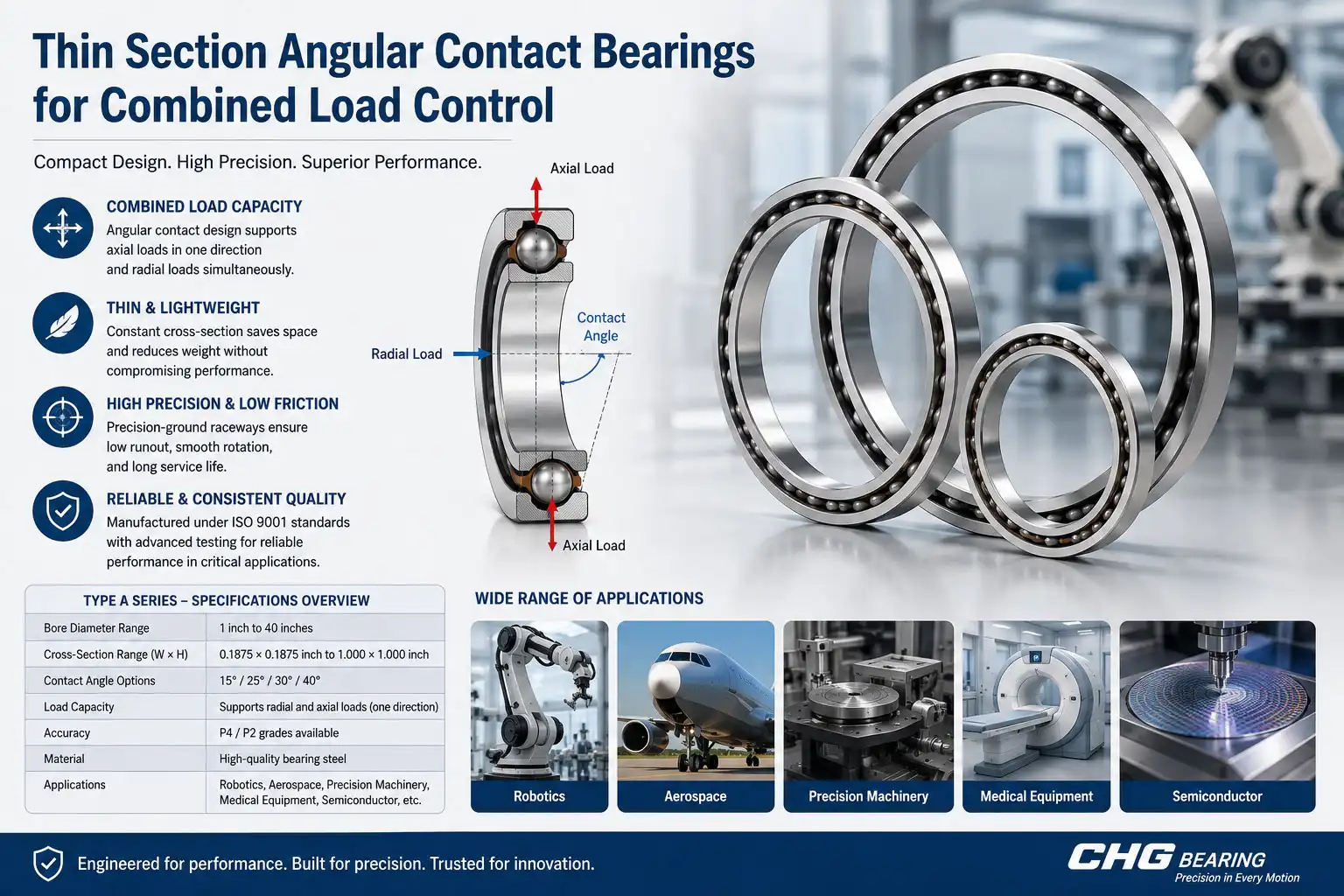
Standard angular contact ball bearings have both the inner bore and cross-section sizes that get bigger as the bore size increases. But Thin Section Angular Contact Bearings keep the cross-section width and height the same across all size ranges. If a creator sticks to a single cross-section family, they can use the same bearing envelope for a range of hole sizes within the same product line. This cuts down on the number of unique parts needed and makes managing inventory easier. The Type A series from CHG Bearing has bore widths ranging from 1 inch to 40 inches and cross-sections ranging from 0.1875 × 0.1875 inch to 1.000 × 1.000 inch. This series covers a wide range of sizes for accurate uses.
Combined Load Handling with Angular Contact Geometry
Thin Section Angular Contact Bearings have an angular contact design that makes an angle of contact between the ball and the raceways. This lets the bearing handle axial forces in one main direction, along with rotational loads. Because of this, they are generally better than radial deep groove bearings in situations where thrust forces are present, like when a robot joint fights against the gravitational moment of a stretched arm or when an aircraft actuator handles airflow loads. Because the cross-section is small, there isn't much of a loss in mass or building size. This makes these bearings the best choice when controlling mixed loads without adding bulk.
Weight Reduction, Friction, and Running Accuracy
Thin Section Angular Contact Bearings and Single Row Tapered Roller Bearings are made to cut down on weight, friction, and false starts while moving, all of which make them very useful for high-performance systems. Lower bearing mass lowers the spinning inertia of joints and axes, which speeds up dynamic reaction times and lowers the power needs of actuators. Low radial and axial runout is caused by the precision-ground raceways and carefully controlled rolling element size in a Single Row Tapered Roller Bearing. This means that the machines they support can repeat their positions. As part of a strict quality process backed by ISO 9001 certification and more than 50 idea patents, CHG Bearing uses CMMs, roundness meters, and friction torque tests to make sure these features are correct for both Thin Section Angular Contact Bearings and Single Row Tapered Roller Bearings.
How to Select the Right Thin Section Angular Contact Bearing for Your Application
Defining Your Load Profile and Contact Angle Requirements
Selecting Thin Section Angular Contact Bearings starts with a thorough analysis of the load environment. Determine the magnitude and direction of both radial and axial forces across all operating modes, including peak transient loads and sustained steady-state conditions. The contact angle of the bearing determines how axial load capacity relates to radial load capacity — a larger contact angle favors axial load handling, while a smaller angle suits predominantly radial applications. For applications with significant moment loading, consider mounting two Thin Section Angular Contact Bearings in a back-to-back or face-to-face arrangement to achieve moment stiffness that a single bearing cannot provide alone.
Bore Diameter, Cross-Section, and Housing Space Constraints
Once the load profile is established, the next step is matching bore diameter to shaft size and selecting the appropriate cross-section within the Type A series. Because the cross-section remains constant within a series, choosing a larger bore does not automatically impose a larger housing bore — the outer diameter grows only by the cross-section increment. This predictability simplifies housing design and allows the same machined housing features to be reused across different bore sizes. CHG Bearing's engineering team can provide guidance on selecting the smallest cross-section that satisfies load and stiffness requirements, keeping system mass and manufacturing costs to a minimum.
Pairing, Preload, and Mounting Arrangement
Thin Section Angular Contact Bearings are frequently used in matched pairs to achieve bidirectional axial load capacity and moment resistance. The pairing arrangement — back-to-back (O-arrangement) or face-to-face (X-arrangement) — determines how the bearing set responds to combined loads and thermal expansion in a Single Row Tapered Roller Bearing application. Back-to-back mounting provides greater moment stiffness and is preferred for cantilevered loads, while face-to-face mounting is more forgiving of shaft deflection. Preload level (light, medium, or heavy) must also be specified: too little preload allows excessive play, while too much generates heat and reduces fatigue life. CHG Bearing's experience with precision thin-section applications and single-row tapered roller bearing solutions ensures correct pairing recommendations for each customer's use case.
Table: Type A Thin Section Angular Contact Bearing — Specifications and Selection Guide
Parameter | Specification / Guidance |
Bore Diameter Range | 1 inch to 40 inches |
Cross-Section Range | 0.1875 × 0.1875 in to 1.000 × 1.000 in |
Section Behavior | Constant cross-section within each series (does not grow with bore) |
Load Types | Radial + unidirectional axial (single bearing); bidirectional in pairs |
Typical Pairing | Back-to-back (moment stiffness) or face-to-face (deflection tolerance) |
Key Industries | Robotics, aerospace, medical devices, precision instruments |
Certifications | ISO 9001 (Quality), ISO 14001 (Environmental) |
Customization | Available — contact CHG Bearing for tailored specifications |
Manufacturer | CHG Bearing (Luoyang Huigong Bearing Technology Co., Ltd.) |
Common Applications in Robotics, Aerospace, and Precision Machinery
Robotics: Joint Actuators and End-Effector Wrists
In collaborative robots and industrial manipulators, every joint must rotate smoothly while resisting the combined gravitational and dynamic loads imposed by the links and payload beyond it. Thin Section Angular Contact Bearings are a natural fit here because they provide angular contact load control within an extremely compact, lightweight package that does not penalize the robot's payload-to-weight ratio. Paired configurations in robot wrist joints handle the complex moment loads generated during tool contact and path changes, while the constant cross-section design allows the same bearing series to be used consistently across shoulder, elbow, and wrist joints, simplifying the supply chain.
Aerospace: Actuators, Gimbals, and Optical Systems
Aerospace applications demand extreme reliability, minimal mass, and consistent performance across wide temperature ranges. Thin Section Angular Contact Bearings are used in flight control surface actuators, antenna gimbal systems, star tracker mounts, and optical telescope pointing mechanisms, where their low mass and high running accuracy are critical. For satellite and space-based applications, specialized materials and lubricants can be specified to accommodate vacuum operation and thermal cycling. CHG Bearing's capability to produce bearings up to 40-inch bore diameter also serves large ground-based radar and astronomical telescope systems, where thin-wall designs enable the lightweight rotating structures demanded by these precision platforms.
Precision Machinery: Medical Devices and Semiconductor Equipment
Medical imaging systems such as CT scanners and robotic surgical platforms require bearings that combine smooth, vibration-free rotation with the compactness needed to fit within patient-proximal mechanical structures. Similarly, semiconductor wafer handling robots and inspection systems operate in cleanroom environments where bearing outgassing, particulate generation, and dimensional stability are tightly controlled. Thin Section Angular Contact Bearings, when specified with appropriate sealing, lubrication, and surface finish, meet these exacting requirements. CHG Bearing's quality management process — including CMM dimensional verification, roundness measurement, and friction torque testing — ensures each bearing meets the tolerance stack-up requirements of these sensitive applications.
Maintenance Strategies to Maximize Performance and Service Life
Lubrication Selection and Replenishment Schedules
Proper lubrication is the single greatest factor in maximizing the service life of Thin Section Angular Contact Bearings and Single Row Tapered Roller Bearings. The thin cross-section means the bearing cavity volume is small, so lubricant quantity and type must be carefully matched to operating speed and temperature in a Single Row Tapered Roller Bearing. Over-greasing generates churning heat in the bearing cavity and can cause seal damage, while under-greasing leads to metal-to-metal contact and accelerated fatigue. For cleanroom or vacuum applications, special low-outgassing greases or solid lubricant coatings are appropriate alternatives. CHG Bearing recommends reviewing lubrication condition at every scheduled maintenance interval and replenishing according to the operating hours and temperature guidelines in the bearing's application data for both Thin Section Angular Contact Bearings and Single Row Tapered Roller Bearings.
Installation Best Practices to Avoid Damage
The thin wall section of Thin Section Angular Contact Bearings makes them more susceptible to distortion during installation than thicker conventional bearings. Force must never be applied through the rolling elements — always press or thermally fit the ring being installed directly on its mating surface. Use appropriate fixtures that contact the entire ring face uniformly to avoid local distortion that would compromise running accuracy and load distribution. Cleanliness during installation is equally important: a single metal chip or abrasive particle introduced during fitting can initiate premature raceway damage. CHG Bearing's technical documentation provides detailed installation guidance specific to thin-section designs.
Condition Monitoring for Early Fault Detection
Even with correct installation and lubrication, Thin Section Angular Contact Bearings operating in demanding environments benefit from proactive condition monitoring. Vibration signature analysis can detect early-stage raceway pitting, cage wear, or ball damage before these defects propagate to sudden failure, allowing planned replacement during scheduled maintenance windows. For precision systems where dimensional changes matter as much as catastrophic failure, periodic measurement of axial and radial play can confirm whether bearing wear has exceeded allowable limits for the system's positional accuracy requirements. Integrating these monitoring practices with CHG Bearing's recommended service intervals helps operators maintain both equipment availability and positioning performance over the full bearing service life.
Conclusion
Thin Section Angular Contact Bearings offer a compelling combination of load control, space efficiency, and precision that few other bearing types can match. Their constant cross-section design simplifies engineering standardization, while angular contact geometry ensures reliable performance under the combined radial and axial loads common in robotics, aerospace, and precision machinery. CHG Bearing, with 25+ years of manufacturing expertise, 40,000 precision thin-section sets produced annually, and rigorous multi-instrument quality verification, is a trusted partner for engineers who need performance without compromise. Selecting the right bearing today directly protects the accuracy and uptime of your system for years ahead.
FAQ
Q1: What is the difference between Type A Thin Section Angular Contact Bearings and standard angular contact bearings?
The key difference is the cross-sectional behavior. In standard angular contact bearings, both the bore and cross-section dimensions increase together as bore size grows. In Type A Thin Section Angular Contact Bearings, the cross-section remains constant regardless of bore size. This allows the same compact bearing envelope to be used across a product line, reducing mass, housing size, and component variety.
Q2: Can Thin Section Angular Contact Bearings handle axial loads in both directions?
A single Thin Section Angular Contact Bearing handles axial loads predominantly in one direction due to its contact angle geometry. For bidirectional axial load capacity, two bearings are typically mounted in a paired arrangement — back-to-back for greater moment stiffness or face-to-face for better accommodation of shaft deflection. CHG Bearing can advise on the correct pairing configuration for your specific application.
Q3: What bore diameter range does CHG Bearing offer for Type A Thin Section Angular Contact Bearings?
CHG Bearing's Type A series covers bore diameters from 1 inch to 40 inches, with cross-sections ranging from 0.1875 × 0.1875 inch to 1.000 × 1.000 inch. This range supports applications from small robotic joints and medical instruments through to large aerospace gimbal systems and precision telescope mounts.
Q4: Are Thin Section Angular Contact Bearings suitable for cleanroom or vacuum environments?
Yes, with appropriate specification. For cleanroom semiconductor and medical applications, low-outgassing greases, stainless steel materials, and sealed or shielded configurations are available. For space or vacuum applications, solid lubricant coatings or specialized vacuum-compatible greases can be specified. CHG Bearing's customization capability allows these environmental requirements to be accommodated without compromising bearing precision or load capacity.
Q5: How does CHG Bearing ensure the quality of its Thin Section Angular Contact Bearings?
CHG Bearing employs over 70 testing instruments — including CMMs, roundness meters, metallographic microscopes, and friction torque testers — to verify dimensional accuracy, surface quality, and performance of every bearing. The company holds ISO 9001 quality management certification, ISO 14001 environmental certification, and over 50 invention patents. With an annual production capacity of 40,000 precision thin-section bearing sets from a 39,330 m² facility in Luoyang, China, CHG Bearing has the scale and technical capability to supply both standard and custom precision bearings reliably.
Specify Your Thin Section Angular Contact Bearing with CHG Bearing — Reach Out Now
Whether you are developing a next-generation robotic system, an aerospace mechanism, or a precision medical instrument, CHG Bearing has the engineering depth and production capability to supply the right Thin Section Angular Contact Bearings and Single Row Tapered Roller Bearing solutions for your project. Since 1998, we have served leading manufacturers worldwide from our Luoyang facility, backed by 150+ production machines, 70+ precision testing instruments, and a team where nearly 30% are engineers and senior technical specialists. We offer both standard catalog bearings and fully customized solutions, including Single Row Tapered Roller Bearing products. Tell us your application requirements and let us recommend the ideal specification. Email our team today at sale@chg-bearing.com — we are ready to help you build something exceptional.
References
1. Harris, T. A., & Kotzalas, M. N. (2007). Rolling Bearing Analysis: Essential Concepts of Bearing Technology (5th ed.). CRC Press.
2. Kaydon Corporation. (2012). Reali-Slim Thin Section Bearings Engineering Catalog (CD4800). Kaydon Corporation.
3. Hamrock, B. J., Schmid, S. R., & Jacobson, B. O. (2004). Fundamentals of Fluid Film Lubrication (2nd ed.). Marcel Dekker.
4. ISO 15:2017. Rolling Bearings — Radial Bearings — Boundary Dimensions, General Plan. International Organization for Standardization.
5. Siciliano, B., Sciavicco, L., Villani, L., & Oriolo, G. (2010). Robotics: Modelling, Planning and Control. Springer.
6. Childs, P. R. N. (2019). Mechanical Design Engineering Handbook (2nd ed.). Butterworth-Heinemann.