

Type X Thin Section Bearings for Automation Systems
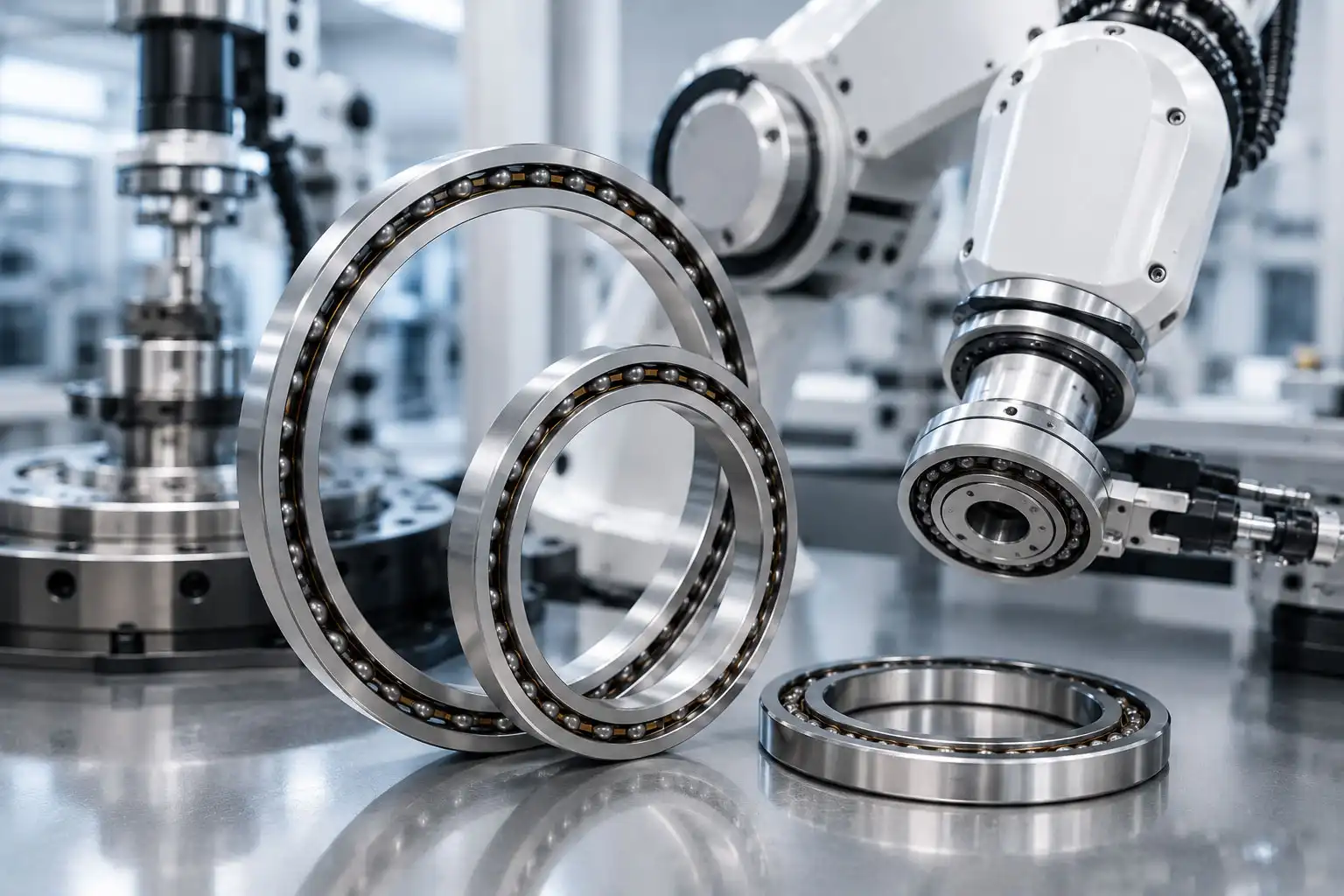
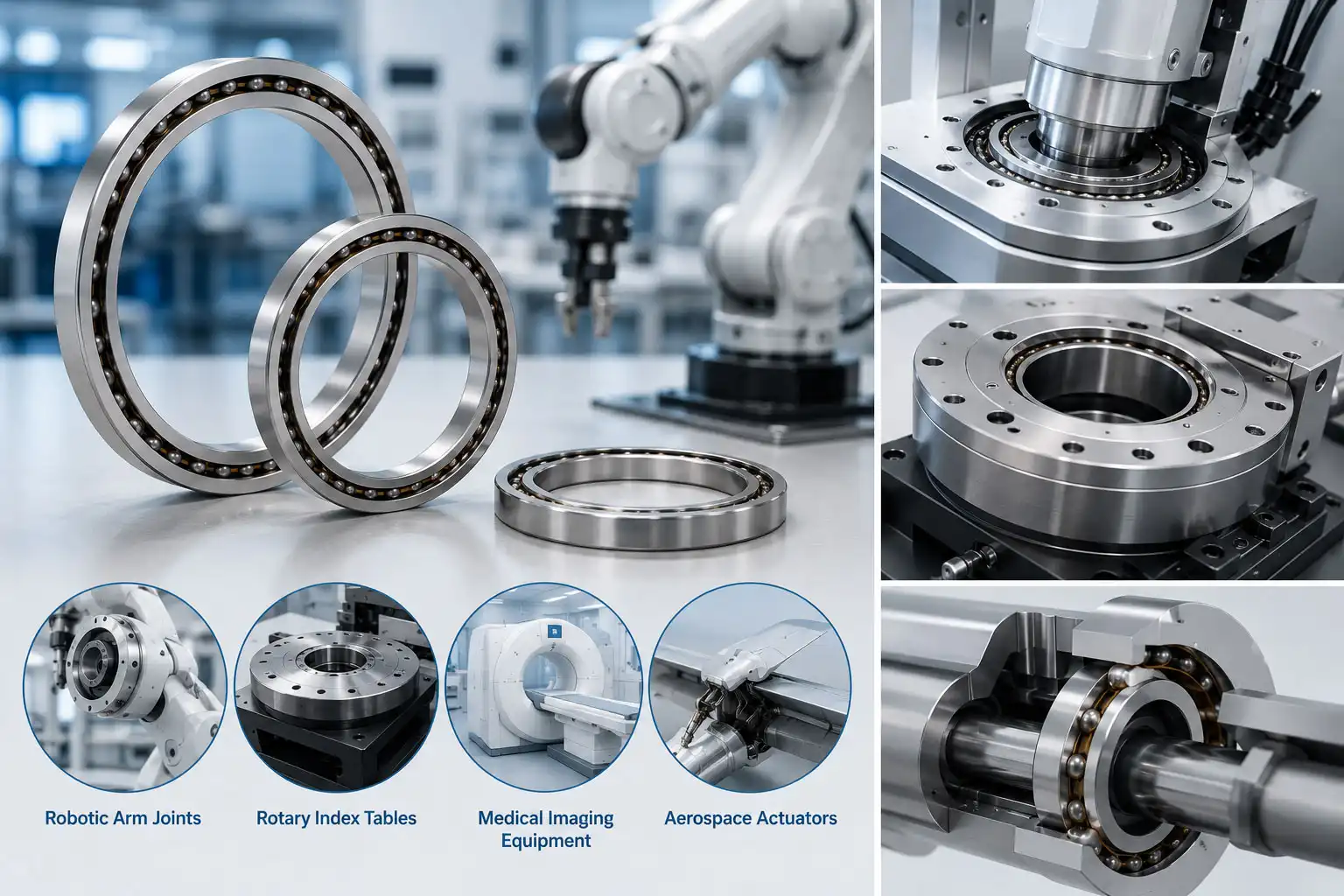
As automation systems grow more sophisticated, every gram of weight and every millimeter of space becomes a design consideration. The Type X Thin Section Bearing addresses these constraints directly, offering a four-point contact ball bearing with an exceptionally slim cross-section that delivers reliable radial and bidirectional axial load capacity without the bulk of conventional bearings. From robotic joint assemblies and semiconductor handling equipment to medical imaging devices and aerospace actuators, the Type X Thin Section Bearing is increasingly the component of choice for engineers who need precision and compactness in the same package. This article explores what sets it apart, how it performs under load, and how to choose the right specification for your application.
What Makes Type X Thin-Section Bearings Ideal for Automation?
A Unique Cross-Section That Stays Constant Across Bore Sizes
The defining characteristic of the Type X Thin Section Bearing is its equal cross-section design — the radial width and axial height of the bearing remain constant regardless of bore diameter. This means that as you scale a robotic arm or automation module to a larger bore size, the bearing's cross-sectional footprint does not grow proportionally as it would with a standard bearing. The result is a predictable, space-efficient envelope that simplifies mechanical design and allows engineers to create lighter, more compact assemblies. With bore diameters ranging from 1 inch to 40 inches and cross-sections from 0.1875 × 0.1875 inch to 1.000 × 1.000 inch, CHG Bearing's Type X Thin Section Bearing covers a wide range of automation scales.
Four-Point Contact for Bidirectional Axial Load Handling
Unlike a standard deep groove ball bearing, the Type X Thin Section Bearing uses a four-point contact geometry that allows a single bearing to carry both radial loads and axial loads in two directions simultaneously. In practice, this means that one Type X Thin Section Bearing can replace two angular contact ball bearings that would otherwise need to be mounted back-to-back or face-to-face to achieve the same bidirectional axial capacity. This consolidation reduces component count, simplifies assembly, and cuts both bill-of-materials cost and housing machining complexity — all significant advantages in high-volume automation manufacturing.
Weight and Size Reduction Without Sacrificing Performance
Automation systems, particularly collaborative robots (cobots), pick-and-place machines, and medical robotic arms, benefit directly from reduced joint and actuator mass. The Type X Thin Section Bearing's slim profile contributes meaningfully to overall system weight reduction, which in turn lowers inertia, improves dynamic response, and reduces the power required from drive motors. CHG Bearing holds over 50 invention patents and is ISO 9001 and ISO 14001 certified, ensuring that the pursuit of compactness in Type X Thin Section Bearing applications never compromises the dimensional accuracy and material integrity that automation-grade performance demands.
Load Capacity and Precision Features Explained
Radial and Axial Load Capability in a Single Component
The four-point contact ball design of the Type X Thin Section Bearing creates two contact points per ball on each raceway groove — effectively behaving like two angular contact bearings in a single row. This geometry efficiently transfers both radial forces (acting perpendicular to the shaft axis) and axial forces (acting along the shaft axis in either direction) through the ball-raceway contact. For automation applications with slow or intermittent rotation — such as joint indexing in robotic arms, rotary table positioning, or antenna pointing mechanisms — this multi-directional load capacity within a thin envelope is a significant engineering advantage.
Dimensional Precision and Running Accuracy
In automation and robotics, the positional accuracy of the end effector depends directly on the dimensional precision of every component in the kinematic chain, and bearings are a critical link. The Type X Thin Section Bearing is manufactured to tight tolerances on bore diameter, outer diameter, width, radial runout, and axial runout. CHG Bearing employs over 70 testing instruments — including coordinate measuring machines (CMMs), roundness meters, and friction torque testers — to verify each bearing before dispatch. This level of quality assurance translates directly into repeatable positioning accuracy, reduced vibration, and smooth, quiet operation in sensitive automation environments.
Suitability for Slow and Intermittent Rotation Profiles
Many automation applications do not involve continuous high-speed rotation. Rotary actuators, index tables, camera pan-tilt units, and surgical robot wrist joints all operate at slow speeds or with frequent starts and stops. The Type X Thin Section Bearing is specifically engineered for these light-to-medium duty, slow or intermittent rotation profiles. Its four-point contact geometry in the Type X Thin Section Bearing maintains stable ball-raceway contact even at low speeds, avoiding the skidding and false brinelling that can affect other bearing types when motion is infrequent. This makes the Type X Thin Section Bearing a particularly reliable choice wherever smooth, controlled movement at low angular velocities is required.
Table: Type X Thin Section Bearing — Key Specifications and Application Fit
Parameter | Detail |
Bearing Type | Four-point contact ball bearing (Type X) |
Bore Diameter Range | 1 inch to 40 inches |
Cross-Section Range | 0.1875 × 0.1875 in to 1.000 × 1.000 in |
Load Types Supported | Radial + bidirectional axial (combined) |
Rotation Profile | Slow or intermittent rotation; light to medium duty |
Angular Contact Equivalent | Replaces two angular contact ball bearings |
Key Benefit | Compact cross-section; constant across all bore sizes |
Certifications | ISO 9001 (Quality), ISO 14001 (Environmental) |
Manufacturer | CHG Bearing (Luoyang Huigong Bearing Technology Co., Ltd.) |
How to Select the Right Type X Thin Section Bearing for Your System
Matching Bore Diameter and Cross-Section to Your Design Space
The starting point for any Type X Thin Section Bearing selection is the available bore diameter and the radial space envelope in your housing. Because cross-section size stays constant as bore diameter increases, a Type X Thin Section Bearing gives you considerable freedom to choose a bore that fits your shaft without worrying that the outer ring will encroach on neighboring components. Once the bore diameter is set, select the smallest cross-section that meets your load and stiffness requirements — moving to a larger cross-section increases load capacity but also increases mass and housing diameter. CHG Bearing's engineering team can assist in evaluating these trade-offs for your specific Type X Thin Section Bearing application in your automation module.
Load Analysis: Identifying Radial and Axial Force Components
A reliable Type X Thin Section Bearing selection requires a clear picture of the forces acting on the bearing during all operating modes — not just peak load moments, but also the direction and frequency of load application. For a robotic joint, this means analyzing gravity loads at various arm configurations, dynamic forces during acceleration and deceleration, and any external contact forces. The four-point contact design handles combined loads well, but if axial forces significantly dominate, or if continuous high-speed rotation is required, a different bearing type may be more appropriate. Consulting CHG Bearing's datasheets alongside your calculated equivalent dynamic load ensures a properly sized selection.
Material, Lubrication, and Environmental Considerations
The operating environment of an automation system can vary widely — cleanroom semiconductor fabrication demands different materials and lubrication choices than outdoor industrial robotics. For cleanroom or medical applications, stainless steel variants and low-outgassing greases are standard requirements. For standard industrial automation, chrome steel with a lithium-based grease provides an excellent balance of corrosion resistance, load capacity, and service life. CHG Bearing's customization capability — backed by 30 years of industry experience and partnerships with leading global manufacturers — allows customers to specify the right material grade, sealing arrangement, and lubrication for their specific operating conditions without compromising the bearing's precision characteristics.
Conclusion
The Type X Thin Section Bearing is a purpose-built solution for the space and weight constraints that define modern automation engineering. Its four-point contact design handles radial and bidirectional axial loads in a single slim component, replacing pairs of angular contact bearings and simplifying system architecture. With bore diameters from 1 to 40 inches and CHG Bearing's rigorous quality standards — 50+ patents, ISO 9001 certification, and 40,000 precision thin section bearings produced annually — it delivers the accuracy and reliability that automation systems demand. The right bearing choice today means fewer redesigns and more dependable performance tomorrow.
FAQ
Q1: Can a single Type X Thin Section Bearing replace two angular contact ball bearings?
Yes. The four-point contact geometry of the Type X Thin Section Bearing provides bidirectional axial load capacity within a single row, which is functionally equivalent to two angular contact ball bearings mounted in opposition. This reduces component count, simplifies housing design, and lowers overall assembly cost without sacrificing load capacity or precision.
Q2: What bore diameter range is available for CHG Bearing's Type X Thin Section Bearings?
CHG Bearing offers Type X Thin Section Bearings with bore diameters ranging from 1 inch to 40 inches. The cross-section ranges from 0.1875 × 0.1875 inch for the smallest sizes up to 1.000 × 1.000 inch, covering applications from compact robotic joints through to large-diameter rotary tables and antenna systems.
Q3: Is the Type X Thin Section Bearing suitable for high-speed continuous rotation?
The Type X Thin Section Bearing is designed primarily for light-to-medium duty applications with slow or intermittent rotation. While it performs reliably at moderate speeds, applications requiring continuous high-speed rotation should be evaluated carefully against the bearing's speed ratings. For high-speed automation spindles, an angular contact or deep groove ball bearing may be more appropriate.
Q4: What industries use Type X Thin Section Bearings most commonly?
Type X Thin Section Bearings are widely used in industrial robotics and collaborative robots, aerospace actuators and antenna mechanisms, medical imaging and surgical equipment, semiconductor wafer handling systems, optical instruments, and consumer electronics assembly automation. Any application combining limited space, precision requirements, and combined radial-axial loading is a strong candidate.
Q5: Can CHG Bearing provide custom Type X Thin Section Bearings for specific applications?
Yes. CHG Bearing offers tailored solutions to meet specific working conditions, including custom material grades, sealing configurations, lubrication types, and dimensional tolerances. With over 30 years of industry experience, more than 50 invention patents, and ISO 9001 certification, CHG Bearing has the engineering capability to develop and produce bearings that go beyond standard catalog specifications.
Get Your Type X Thin Section Bearing Quote — Contact CHG Bearing Today
If you are designing an automation system, robotic assembly, or precision instrument and need a bearing that delivers in tight spaces, CHG Bearing is ready to help with Type X Thin Section Bearing solutions. Since 1998, our Luoyang facility — spanning 39,330 m² with 150+ production machines and 70+ precision testing instruments — has supplied high-reliability thin section bearings, including Type X Thin Section Bearing, to leading manufacturers worldwide. With an annual capacity of 40,000 precision thin-section bearing sets, we have the scale to support both prototype and production volumes. Share your application requirements with our engineering team and receive expert guidance on the right Type X Thin Section Bearing for your system. Email us at sale@chg-bearing.com — we look forward to working with you.
References
1. Hamrock, B. J., Schmid, S. R., & Jacobson, B. O. (2004). Fundamentals of Fluid Film Lubrication (2nd ed.). Marcel Dekker.
2. Harris, T. A., & Kotzalas, M. N. (2007). Rolling Bearing Analysis: Essential Concepts of Bearing Technology (5th ed.). CRC Press.
3. Kaydon Corporation. (2012). Reali-Slim Thin Section Bearings Engineering Catalog (CD4800). Kaydon Corporation.
4. ISO 15:2017. Rolling Bearings — Radial Bearings — Boundary Dimensions, General Plan. International Organization for Standardization.
5. Siciliano, B., Sciavicco, L., Villani, L., & Oriolo, G. (2010). Robotics: Modelling, Planning and Control. Springer.
6. Childs, P. R. N. (2019). Mechanical Design Engineering Handbook (2nd ed.). Butterworth-Heinemann.