

Why Are Tapered Roller Thrust Bearings Essential for Heavy-Duty Machinery?
Tapered roller thrust bearings are critical components engineered to handle high axial loads with precision and long-lasting durability. Unlike conventional radial bearings, they use tapered rollers arranged at a specific angle, efficiently transferring axial forces along the roller axis. This design ensures stable performance in heavy-duty industrial equipment, including metallurgy, mining, construction machinery, and power generation. Choosing the wrong bearing can lead to costly downtime, misalignment, and premature wear. This guide highlights the key features, advantages, applications, and selection criteria for tapered roller thrust bearings, with insights into CHG Bearing’s high-performance solutions.
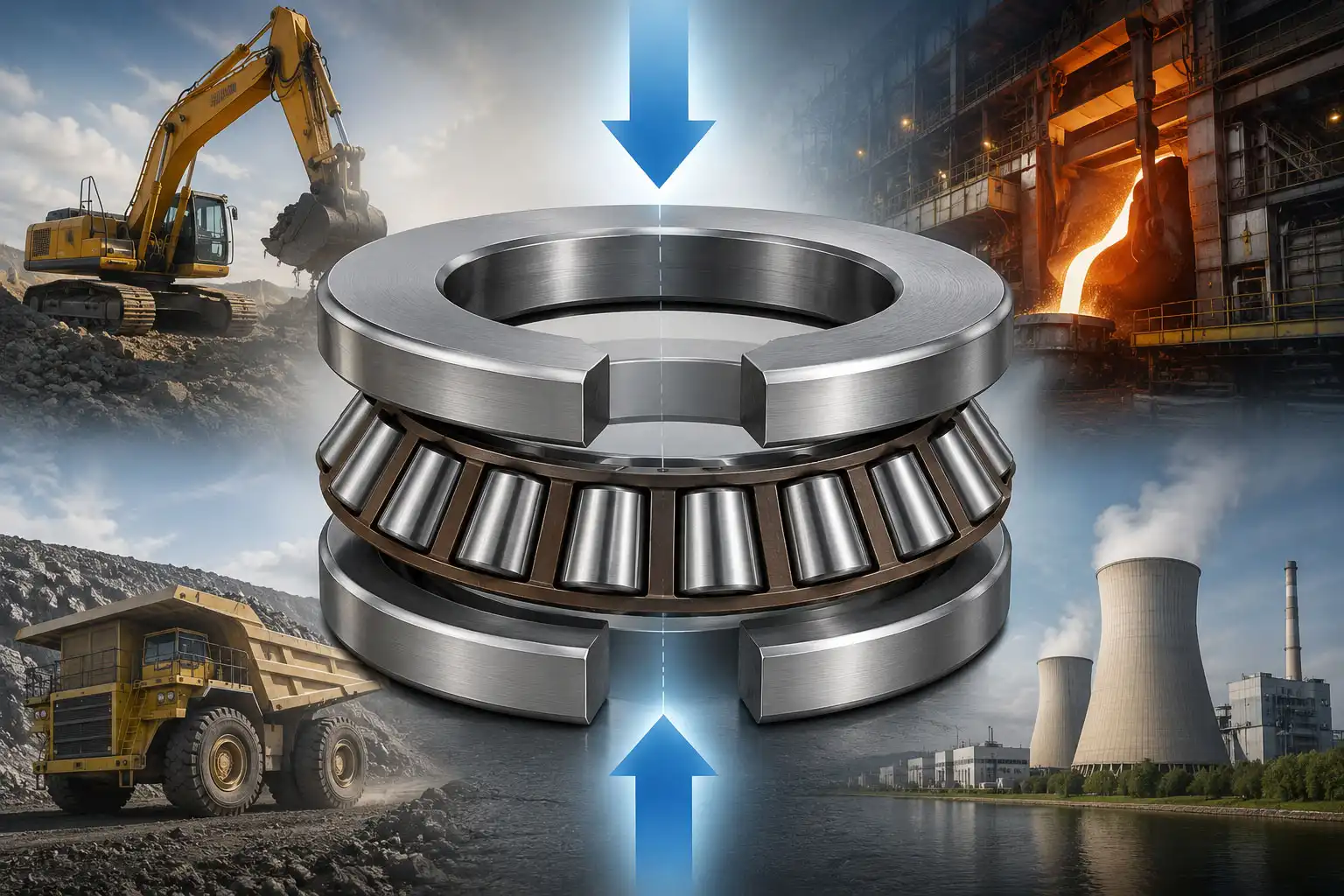
How Do Tapered Roller Thrust Bearings Handle Heavy Axial Loads?
The Role of Tapered Roller Geometry
The unique geometry of tapered roller thrust bearings is central to their performance. Each roller is shaped like a truncated cone, and the inner and outer raceways are tapered at matching angles. This design distributes axial loads along the full roller length, reducing point stress and ensuring smooth load transfer. This “line contact” principle allows tapered roller thrust bearings to outperform ball-type thrust bearings in heavy-load conditions, providing stable and durable performance.
Axial Load Limitation and Locating Function
Tapered roller thrust bearings are specialized for axial loads only—they do not support radial forces. This is an advantage in machine designs where precise shaft positioning is critical. By controlling axial displacement in one direction, these bearings prevent misalignment in large presses, turbines, gearboxes, and other heavy rotating equipment. Accurate axial positioning reduces wear, prolongs machine life, and minimizes maintenance requirements.
Comparing with Cylindrical Roller Thrust Bearings
While both designs handle axial loads, tapered roller thrust bearings provide higher load capacity and lower slippage due to their geometry. This reduces heat generation and wear, making them ideal for slow- to medium-speed, high-load applications. Cylindrical roller thrust bearings may be chosen for higher-speed environments, but they do not match tapered designs for maximum axial load capacity.
Specification | Details |
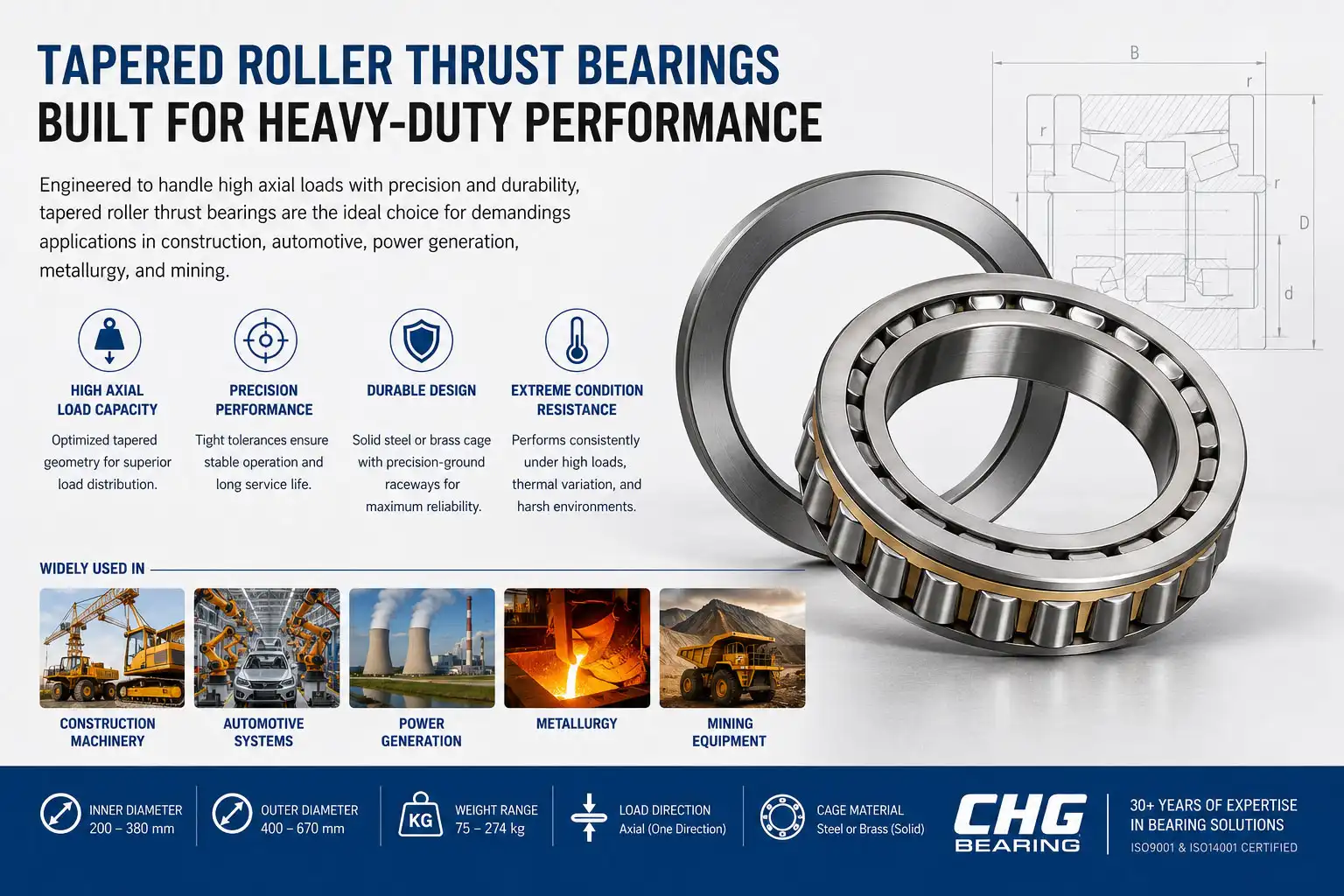
Inner Diameter | 200–380 mm |
Outer Diameter | 400–670 mm |
Weight | 75–274 kg |
Cage Material | Steel or Brass (Solid) |
Load Direction | Axial (one direction) |
Applications | Construction, Automotive, Power Generation |
High Load Capacity and Precision Performance Advantages
Durable Structural Design
CHG Bearing uses solid steel or brass cages in all tapered roller thrust bearings. Solid cages maintain roller spacing under heavy load and high-speed conditions, reducing the risk of cage failure. Precision-ground raceways ensure consistent roller contact across all load levels, resulting in lower vibration, smoother rotation, and longer bearing life.
Precision Tolerances and Dimensional Stability
CHG Bearing manufactures bearings to ISO9001-certified quality standards, ensuring tight axial and radial tolerances. Inner diameters range from 200 to 380 mm and outer diameters from 400 to 670 mm, accommodating various heavy machinery sizes. Unit weights from 75 to 274 kg demonstrate the robustness required for demanding industrial applications.
Performance in Extreme Conditions
Tapered roller thrust bearings resist deformation and fatigue even under continuous high-load cycles, thermal variation, and harsh environmental conditions. Their dimensional stability ensures minimal thermal drift and consistent axial clearance, reducing unplanned downtime—a critical factor for high-productivity industries.
Why Are Tapered Roller Thrust Bearings Used in Industrial Machinery?
Construction and Heavy Equipment
In cranes, excavators, and lifting machinery, these bearings act as precise axial locators, preventing shaft migration under heavy loads. Shock absorption and vibration resistance make them ideal for construction environments, while delivering consistent performance for long service life.
Automotive and Power Generation Applications
Tapered roller thrust bearings are used in transmission systems, differential assemblies, and industrial generators. Their ability to handle variable axial loads ensures reliability in drivetrain components and rotating shafts, making them preferred in automotive and power generation sectors.
Metallurgy and Mining Environments
Extreme temperatures, heavy contamination, and massive continuous loads make metallurgy and mining challenging for bearings. Tapered roller thrust bearings provide maximum load capacity and durability, while CHG Bearing’s decades of experience ensure reliable solutions for these environments.
Feature | Tapered Roller Thrust | Cylindrical Roller Thrust |
Axial Load Capacity | Higher | Standard |
Relative Slippage | Lower | Higher |
Limiting Speed | Lower | Higher |
Axial Displacement Control | One direction | One direction |
Cage Material | Steel or Brass | Steel |
Typical Industries | Mining, Metallurgy, Construction | General industrial |
How to Choose the Right Tapered Roller Thrust Bearing
Key Selection Criteria
- Axial Load Magnitude & Direction: Bearings only handle one-direction axial loads.
- Operating Speed: Suited for slow to medium-speed applications.
- Dimensional Constraints: Match shaft and housing dimensions with available inner diameters (200–380 mm).
Environmental Considerations
- Cage Material Choice: Steel for shock-loaded environments, brass for higher-speed or high-temperature applications.
- Custom Solutions: CHG Bearing can tailor cage materials, surface treatments, and sizes to meet extreme conditions.
Why Choose CHG Bearing
With 30+ years of expertise, CHG Bearing delivers high-performance tapered roller thrust bearings with ISO9001 and ISO14001 certifications. Facilities include over 150 main production units and 70+ testing instruments for consistent quality. Our team supports standard and fully customized solutions, backed by 50+ patents and decades of industrial experience.
Conclusion
Tapered roller thrust bearings are essential for high-load, high-precision industrial applications. CHG Bearing offers robust designs, precise tolerances, and reliable performance across construction, automotive, power generation, and mining sectors. Whether standard or custom, CHG Bearing provides solutions engineered for durability and long-term reliability.
FAQ
Q1: What loads can tapered roller thrust bearings handle?
Axial loads in one direction only; not suitable for radial forces.
Q2: How do they compare to cylindrical roller thrust bearings?
Higher axial capacity, lower slippage, better for slow- to medium-speed heavy loads.
Q3: What cage materials are available?
Solid steel or solid brass, customizable for high-speed or shock-loaded environments.
Q4: What size range is offered?
Inner diameters 200–380 mm, outer diameters 400–670 mm, weight 75–274 kg.
Q5: Which industries commonly use these bearings?
Construction, automotive, power generation, metallurgy, and mining.
Partner with CHG Bearing
CHG Bearing engineers can help select and customize tapered roller thrust bearings for your application. Contact us at sale@chg-bearing.com to request a consultation or quotation. Ensure your machinery operates reliably with CHG Bearing solutions.
References
1. Harris, T. A., & Kotzalas, M. N. (2006). Rolling Bearing Analysis: Essential Concepts of Bearing Technology (5th ed.). CRC Press.
2. SKF Group. (2018). SKF Rolling Bearings Catalogue. SKF AB.
3. Tedric A. Harris. (2001). Rolling Bearing Analysis. John Wiley & Sons.
4. ISO 355:2007. Rolling Bearings – Tapered Roller Bearings – Boundary Dimensions and Series Designations. International Organization for Standardization.
5. Eschmann, P., Hasbargen, L., & Weigand, K. (1985). Ball and Roller Bearings: Theory, Design and Application. John Wiley & Sons.
6. Shigley, J. E., & Mischke, C. R. (2001). Mechanical Engineering Design (6th ed.). McGraw-Hill.